
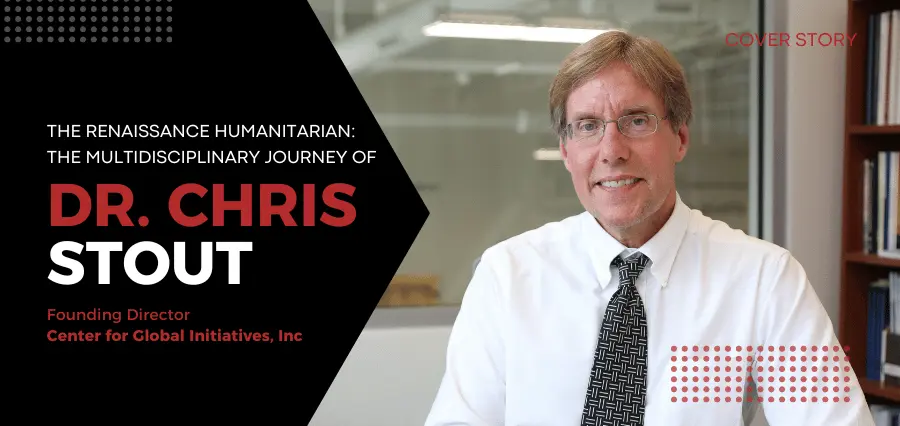
In an era defined by hyper-specialization, Dr. Chris Stout stands as a definitive “walking, talking Venn diagram.” A clinical psychologist by training, an entrepreneur by instinct, and a humanitarian by calling, Chris has spent the better part of four decades weaving together the disparate threads of technology, medicine, global health, and behavioral science.
From the lecture halls of Northwestern University to the high-stakes corridors of the United Nations and the World Economic Forum in Davos, his career is a masterclass in what he calls ‘living a life in full’—a relentless pursuit of multidisciplinary impact that refuses to be confined by traditional professional boundaries.
A Foundation Built on Resilience: The “Blueprint” Origins
The professional biography of Chris is a narrative of improbable ascent fueled by grit. Born into modest circumstances and raised by a single mother, Chris faced early hurdles that might have sidelined a less determined individual.
Struggling with undiagnosed dyslexia and childhood obesity—a cruel irony given his last name—he was often the target of bullying. Yet, it was during these formative years that he discovered a 1972 issue of LIFE magazine featuring world-adventurer John Goddard’s “List” of 127 life goals.
Inspired, a teenage Chris created his own ‘blueprint,’ a list that would eventually see him summiting three of the world’s “Seven Summits,” running ultramarathons, and becoming the first in his family to graduate from college. This early realization—that life could be designed rather than merely endured—became the bedrock of his professional philosophy.
After earning his doctorate in clinical psychology (where he was Valedictorian) and completing a prestigious postdoctoral fellowship at Harvard Medical School in neurodevelopmental behavioral pediatrics, Chris didn’t just enter the workforce; he began building a global legacy.
Academic Excellence and State Leadership
Chris’s academic pedigree is as deep as it is broad. He held appointments as a Clinical Full Professor in the College of Medicine at the University of Illinois at Chicago’s Department of Psychiatry, and he served as faculty at Northwestern University’s Feinberg School of Medicine’s Department of Psychiatry and Behavioral Sciences. His scholarly output is staggering: with over 300 papers and 38 books to his name, many of which reside in the Library of Congress, he has been recognized as one of the most frequently cited psychologists in scientific literature.
His leadership is equally felt in the public sector. As the first Chief of Psychological Services for the State of Illinois, he served as the highest-ranking psychologist in the state, managing a cabinet-level position. In this role, he was a committed reformer, overseeing psychological services across the Department of Human Services and Division of Mental Health. He pioneered the integration of clinical information systems, serving as Chief Clinical Information Officer to modernize how the state tracked and improved mental health outcomes. This ability to navigate complex governmental bureaucracies while maintaining a focus on ‘in-the-trenches’ care is perhaps his most defining leadership trait.
The Global Stage: From the UN to Davos
Chris’s leadership journey is characterized by a citizen-diplomat approach. He doesn’t just study global problems; he inserts himself into the machinery meant to solve them. His tenure as a Special Representative to the United Nations allowed him to advocate for psychological principles in international policy, emphasizing that global stability is inextricably linked to mental well-being.
He chaired the Legislative Affairs Committee for the Illinois Psychological Association (IPA) and provided formal testimony to government panels on healthcare needs, ensuring that the voice of behavioral science reached the highest levels of policy.
This work caught the attention of the World Economic Forum, which appointed him as one of its Global Leaders of Tomorrow—a distinction he shared with figures like Bill Gates, Tony Blair, and J.K. Rowling. As an invited faculty member at the annual meeting in Davos, Chris has consistently pushed for the inclusion of behavioral science in global economic strategies. He argues that we cannot have economic sustainability or physical health without addressing the psychological trauma inherent in poverty and conflict.
The Center for Global Initiatives: Open-Sourcing Humanitarianism
If you ask Chris about his greatest achievement, he is unlikely to point to his four honorary doctorates or his Hall of Fame inductions. Instead, he might point to a small kindergarten in Tanzania. Through his award-winning nonprofit, The Center for Global Initiatives (CGI), Chris has championed a model of ‘open-sourcing humanitarian intervention.’
CGI operates on a lean, all-volunteer model, ensuring that resources go directly to projects that need them most. The center functions as an incubator for healthcare innovation, focusing on underserved and refugee populations.
Chris’s approach is decentralized and agile—what he calls ‘guerrilla humanitarianism.’ Whether it is providing medical missions to the Amazon with the Flying Doctors of America or developing sustainable health programs in post-conflict zones like Rwanda and Vietnam, Chris’s impact is measured in lives improved rather than just papers published.
His award-winning three-volume set, The New Humanitarians, serves as a roadmap for this new era of activism. In these volumes, he highlights the “rebels with a cause“—innovators who bypass bureaucracy to deliver results. For Chris, health is the most common denominator for a region’s success, inextricably linked to eradicating poverty and preventing violence.
Insights on Technology-Enabled Care and Global Health
Central to Chris’s modern work is the belief that technology is a force multiplier for humanitarian efforts. He has been a vocal advocate for Humanitarian Innovation, particularly through the use of technology to bridge the disconnection in global healthcare systems.
“We are at a crossroads where AI and digital therapeutics can bridge the gap in care that traditional infrastructure cannot,” Chris often notes. He has consulted on the development of “Software as a Medical Device” (SaaMD) and prescription digital therapeutics, seeing these not as replacements for human care, but as essential tools for scale.
His work with startups like Yubi Health Inc. and Prevail Health focuses on using data analytics and AI-powered wellness to identify and intervene in healthcare needs before they become crises. In recognition of this, he was recently named one of the “Top 111 Forward Thinkers” for his work in AI-powered wellness and human evolution.
The Podcast: Living a Life in Full
Beyond the clinic and the classroom, Chris shares his wisdom through his popular podcast, Living a Life in Full. The show serves as a gym membership for the brain, featuring conversations with Nobel Laureates, astronauts, and world-class athletes. It is here that Chris’s personal mission becomes clearest: he wants to help others blueprint their own lives, moving past mediocrity toward a state of leaving a legacy through positive influence.
The podcast covers a wide range of topics—from behavioral finance and retirement planning to the psychology of terrorism. It reflects Chris’s own curiosity and his belief that a well-lived life is graduate-level in its depth but kindergarten-level in its wonder. With a following in the millions, the show has become a primary vehicle for his message that everyone has the capacity to be a vector of change.
A Legacy of Impactful Milestones
To list Dr. Stout’s achievements is to catalog a lifetime of relentless productivity:
- Literary Impact: 38 books, including The Psychology of Terrorism and The New Humanitarians, translated into 8 languages.
- Humanitarian Missions: Work in over 100 countries and 6 continents, from the Amazon to Russia with War Child.
- Recognition: Recipient of the APA’s International Humanitarian Award, the Science Medallion of Distinction, and the APA calling him their International Rockstar, and Illinois’ Distinguished Psychologist of the Year.
- Adventures: Summitting three of the world’s 7 summits, along with Mt. Rainier, Mt. Whitney, Adam’s Peak in Sri Lanka, and Pikes Peak (with his daughter); ultra-running and scuba diving despite a childhood fear of water.
The Evocative Spirit
Today, Chris continues to operate at the intersection of diverse domains. Whether he is advising a healthcare startup, writing a Pulitzer-nominated editorial, or planning his next mountaineering expedition, his goal remains the same: to use every tool at his disposal—be it a book, a clinical protocol, or a nonprofit initiative—to make the world a slightly more humane place.
As noted in his APA citation, he is a “rare individual who takes risks, stimulates new ideas, and enlarges possibilities in areas of great need.” Chris remains a provocative thinker and an evocative spirit, proving that the most effective way to change the world is, quite simply, to live a life in full.