
The Rath Yatra of Puri Explained: Inside the Largest Chariot Festival in the World
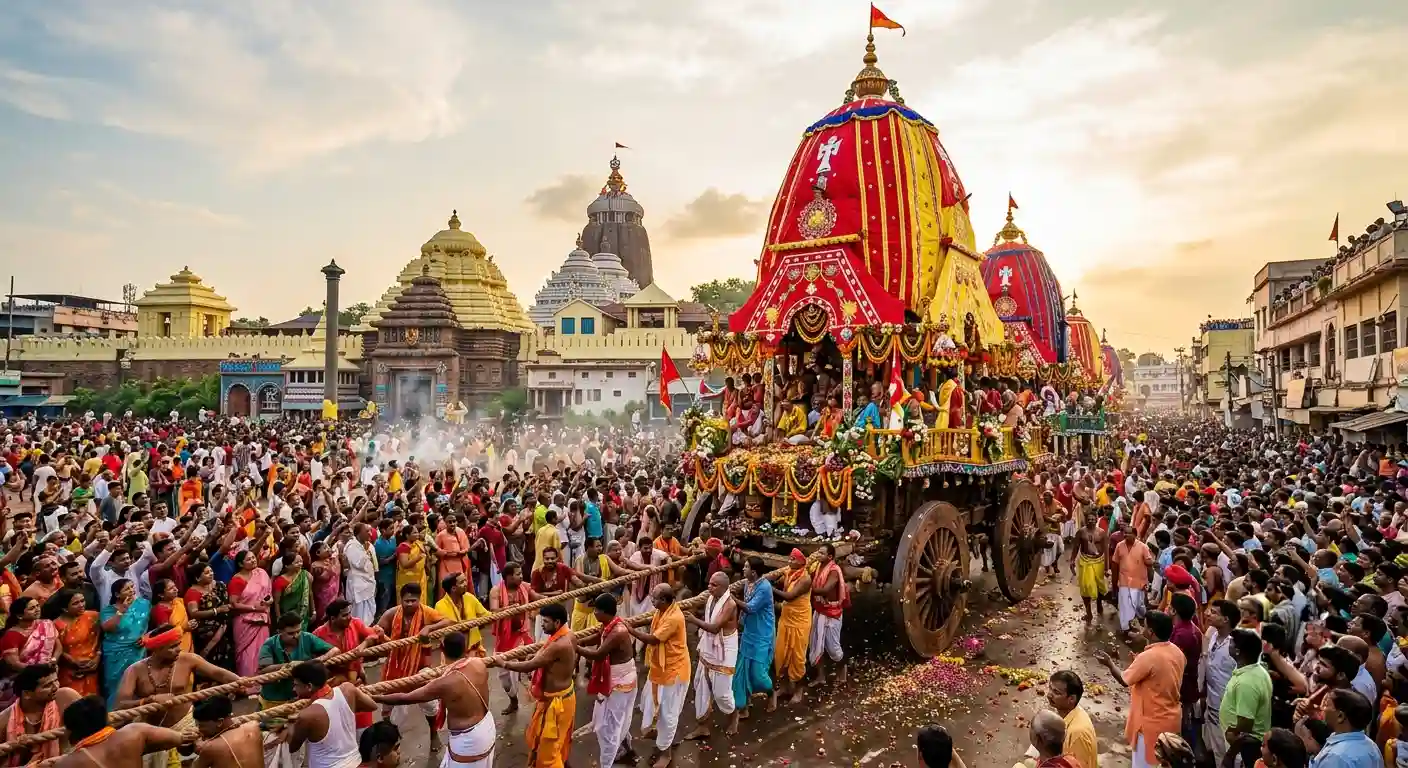
The Rath Yatra of Puri is the world’s largest chariot festival, where the idols of Lord Jagannath, Balabhadra, and Subhadra are carried on massive wooden chariots through the streets of Puri, Odisha.
Hewn from wood and fitted with stub-like arms and almond-shaped eyes, the idol emerges from the Jagannath Temple every summer. It’s carried down stone steps and loaded onto a towering chariot roughly as tall as a four-storey building before hundreds of thousands of people grab ropes attached to its sides and pull the entire structure through the streets of the eastern coastal town of Puri, Odisha. It’s known as the Rath Yatra of Puri the Chariot Festival of Lord Jagannath and it’s easily the largest chariot festival in the world.
The History of the Festival
Dedicated to Lord Jagannath an incarnation of Vishnu (Krishna) the Rath Yatra features his idols as they’re paraded alongside those of his elder brother Balabhadra and younger sister Subhadra. Once a year, the trio are drawn by “hundreds of thousands of devotees” in three ornate wooden chariots down Puri’s grand avenue, known as Bada Danda. Their destination? The Gundicha Temple, about three kilometers away from the main shrine, where they stay for approximately one week before making the return trip.
Legend says the journey began because Subhadra wanted to see the town she lived in and her brothers took her on a chariot ride to indulge her. Other lore states that the trio visits Jagannath’s aunt during the annual pilgrimage, with Gundicha Temple acting as her home. Either way you look at it, the scriptural basis for the journey dates back to ancient texts such as the Brahma Purana, Padma Purana, Skanda Purana and Kapila Samhita.
According to tradition, the deities were built by divine architect Vishwakarma, who carved them from sacred neem wood although King Indradyumna is said to have dreamt the gods told him to build a temple for Jagannath and shape his remains into wooden figures.
The idols are replaced every twelve to nineteen years in a ceremony called Nabakalebara.
Still, while legend paints the festival as ancient, the very earliest historical records credit real-life rulers. The first recorded celebration of the Rath Yatra in Puri was conducted by King Indradyumna, who commissioned the construction of the Jagannath Temple; it continued through the centuries under sponsorship from Odisha’s Ganga and Gajapati dynasties. In modern times, historians estimate its inception took place around the 12th century.
Fun Fact: Where the Word “Juggernaut” Comes From -
In the west, a “juggernaut” is typically an unstoppable force. In India, it began as spectators’ impressions of the massive chariots rolling through Puri during the Ratha Yatra.
The Chariots of Lord Jagannath, Balabhadra, and Subhadra
Despite being made almost entirely from wood, the chariots of Jagannath, Balabhadra and Subhadra are built anew each year. Each chariot’s colour, dimensions and decorations vary slightly depending on which deity it carries.
Nandighosa, the chariot of Lord Jagannath, towers over the other two at about 45 feet high with a base approximately 35-feet square. Standing on 16 wheels, the chariot is painted bright yellow and red with decorations based on scenes from Krishna Leela.
Balabhadra and Subhadra’s chariots Taladhwaja and Darpadalana, respectively are slightly smaller, but no less lavish.
Nine painted wooden figures known as Parsva devatas flank each chariot, and each has its own charioteer as well as four horses.
The wood used to construct the chariots has its own story too. Traditionally, the logs are floated downriver as rafts on the Mahanadi before being caught near Puri and brought to the temple by road.
Timeline: The Ratha Yatra of Puri Rituals, Explained
On full moon day of Hindu month Jyeshtha, the trio is given a ceremonial bath known as Snana Yatra. Holy water for the cleansing ritual is drawn from a well called Suna Kua or the Golden Well, and the deities are said to be bathed with 108 pitchers of water.
After their cleansing, the deities become sick from bathing and are sequestered for about two weeks prior to the procession. This mourning period is known as Anasara.
During Pahandi, the deities are brought out of the shrine and into the temple’s outer sanctum amid chants and drumming before being placed on their respective chariots.
Chhera Pahanra is easily one of the most meaningful events during the Ratha Yatra. The Gundicha Temple’s sponsor usually the Gajapati King of Puri sweeps the street in front of the chariots with a golden broom and sprinkles them with sandalwood water. The ritual signifies that all are equal in front of the Lord.
Pulling the Chariots of Lord Jagannath, Balabhadra, and Subhadra
This is the day of the big journey. Once everyone’s prepared to make the trek, attendees pull the three chariots via thick rope along the roughly three-kilometer course. Hauling the wood and stone can take several hours, but believers say the act cleanses participants of sin.
As they’re carted through the streets, traditional singers known as Dahuka chant bawdy verses considered necessary to help propel the massive vehicles.
While at Gundicha Temple, Jagannath, Balabhadra and Subhadra stay for about one week. During their stay, they receive gifts of Poda Pitha, a specially-made baked pancake.
Hera Panchami involves Goddess Lakshmi paying the trio a visit. Because she wasn’t invited on the journey to Gundicha Temple, the goddess travels there incognito in a palanquin to confront the Lord. To appease her, Jagannath offers her a garland.
Bahuda Yatra means “The Return Journey.” On the eighth day of the festival, the deities depart Gundicha Temple for good and make the trip back to the Jagannath Temple. With them, they carry Poda Pitha, which is offered to them near the Mausi Maa Temple along the way back.
On this day, the deities are adorned in gold ornaments while they’re still out on the chariots. Traditionally, devotes dress them in gold because of a tale that dates back to 1460, when King Kapilendra Deva donated gold to Jagannath after conquering his enemies in battle. Each deity is adorned with nearly 208 kg of gold jewelry.
Why the Rath Yatra of Puri Is the Largest Festival of Its Kind
It’s difficult to overstate how massive the Rath Yatra in Puri can be. In 2014, “almost nine hundred thousand” devotees watched the Suna Besha ceremony alone. The following year saw lakhs attend what would become Odisha’s largest religious congregation in history.
Attendance has only ballooned in recent years. Millions of pilgrims are expected to attend next year’s festival, an increase from last year’s estimates of over half a million. In fact, future celebrations are expected to break records after the 2025 event integrated digital technology with traditional crowds, letting viewers across the world attend virtually.
Of related festivals, Ahmedabad hosts India’s third-largest Rath Yatra. Others are celebrated across Bengal, Manipur, Bangladesh and in places with Hindu diaspora populations like Singapore. None are so massive or ancient as the Rath Yatra of Puri; its sister festival in Mahesh, West Bengal is the second oldest running chariot festival in India and has been held continuously since 1396 CE.
In many ways, that longevity is the Rath Yatra’s greatest secret. While spectacles like the incredible chariots draw visitors from around India and the world, the festival’s core rituals promote a powerful message of equality. Kings sweep the ground their subjects walk upon, while deities can be pulled by any person who seeks to take hold of the ropes regardless of caste or social standing.
At its heart, the festival promises change. With the help of millions of devotees returning year after year to participate, the Rath Yatra of Puri is rebuilt from scratch annually. For nearly a millennia, those worshipers have returned for another ride. That, more so than sweeping mythology or golden jewelry, might be why India’s largest pilgrimage continues to grow with each passing year: because it isn’t just history. The Rath Yatra of Puri is a living, evolving tradition.