
How Artificial Intelligence Works in Simple Words
Artificial Intelligence (AI) is transforming the world around us. Learn how AI works in simple words, how machines learn from data, and why AI is becoming an essential part of modern technology.
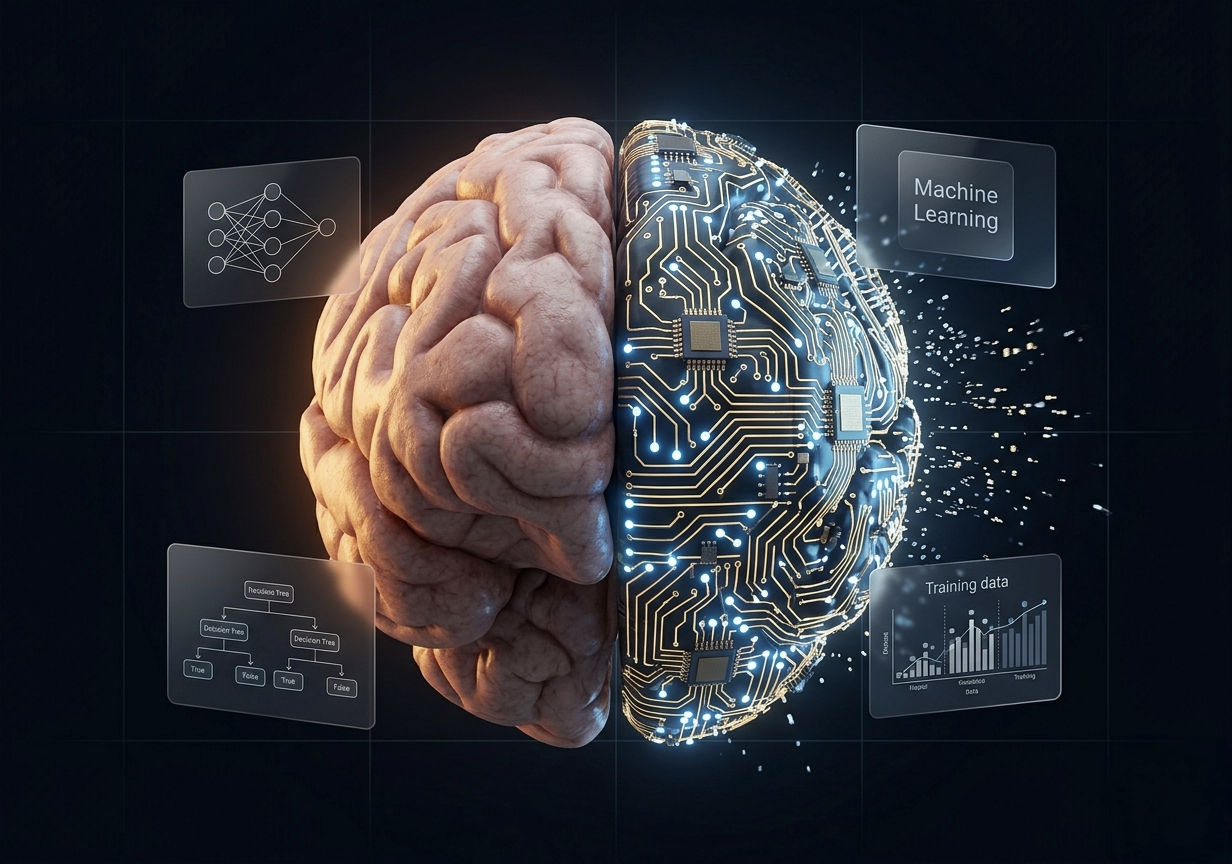
Artificial Intelligence, or AI, is a buzzword that you must have heard a hundred times.Be it robots or drones, AI is everywhere, and it is only going to grow further.However, many still find AI to be an obscure and hard concept to understand.The truth is, AI is simple, once you break it down into layman's terms. There is no wizardry or sorcery involved in AI. It is the process of getting computers to do things, which is usually done by human beings, like recognizing patterns or facts, making decisions or learning from past experiences. It is simple to understand, and a little knowledge of AI can go a long way for all of us, as AI is being used widely, and changing the way all industries function globally.
Artificial Intelligence simply means enabling a machine to 'think', well to some degree.Machines don't have any emotions, senses or consciousness like human beings, but they can analyze a large amount of information, detect patterns in it and predict what will happen based on the data fed to them. Computers are able to do this so well, because they have the capability to analyze and sort information at a very fast pace. As they do this, the computers learn and become even more accurate in what they do, with time.
Understanding the Basics: Machine Learning and Algorithms
AI machines can learn, through a process called Machine Learning.This is the process where a computer is 'taught' to think.You can imagine it like teaching a toddler to recognize a cat.You will show a toddler a few pictures of cats and tell him / her about the patterns, fur, whiskers, tail etc.which indicate the presence of a cat in the picture.The toddler will then go on to point out the presence of cats in any new picture it sees, based on the patterns it has learnt to recognize.Machine learning is no different, except, the toddler is a computer program and the pictures are data.
This data is in the form of images, text, audio, video or even numbers.This information is fed to the AI system and the system analyses this data, detects the patterns and the relationships, and formulates a model, to be able to make predictions or decisions based on this data, just like our toddler did.A AI model, fed with a lot of pictures of cats and dogs, can recognize a cat or a dog in a new picture, just as the toddler did.This is only one example.The more data is fed to this model, the better it is at predicting what it will find in new data.
Different Types of AI
AI can be in the form of a simple program, written to complete a repetitive task or process, or it can be an advanced system which is able to mimic human intelligence in making decisions and problem - solving.Narrow AI is the name given to AI systems, which can perform a single dedicated task really well, for example.Virtual voice assistants like Siri or Alexa, recommendation systems which power all those shows and movies you like watching on Netflix or Amazon, and even the spam filters which filter your emails in the Spam folder, are all examples of Narrow AI systems.
The other form of AI is a General AI, which is one that has the capabilities of human intelligence and can perform a variety of tasks well.This has not been achieved yet and is a far - off goal of AI research.Narrow AI is present in almost all walks of our daily lives.AI systems which can 'think' in the manner of a human being, is something that would require a lot more research and would be available in the future.
Neural Networks
A neural network is an AI system that is designed to loosely imitate the functions of a human brain.A neural network is made up of multiple layers, with interconnected 'neurons' in each layer.These 'neurons' transmit and process data to each other.Each connection between the neurons has an associated weight, which is adjusted as it 'learns' from its experiences.Neural networks are great at tasks like image and speech recognition, or at understanding human language.
When you upload a photograph on your social media page, where your friends are tagged automatically, this is a neural network at work.Facial recognition is done by detecting patterns in the pixel data of the image which you upload and based on that, accurate predictions are made.Chatbots which are used in answering questions, as well as many self - driving car applications, also use neural networks.
Natural Language Processing
Natural Language Processing, as the name implies is the ability of a computer to understand and process human language.NLP is a subfield of AI which powers chatbots, virtual voice assistants, translation systems, voice search, speech to text and text analytics tools.NLP is what helps your voice assistant to interpret your words, and understand the context of your conversation, and then deliver the weather update to you.
Machine learning works by a combination of machine learning models and a set of linguistic rules.This makes it possible for computers to understand grammar, context and other nuances of the language.Sarcasm or idioms are an example of some of the more complex elements of a language that an NLP program needs to identify and recognize.
AI in Day to Day Life
AI is all around us.Have you ever noticed those recommendation emails you get when shopping online, to purchase other products you have looked at, but not yet bought, or similar items which you might like ? These recommendation systems are powered by AI.AI also detects fraudulent credit card transactions, by detecting unusual patterns of activity.In the medical field, AI algorithms are used for image analysis, to find tumours and cysts, predict patient outcomes or suggest treatment options.
AI systems are even used by the most popular media streaming platforms to recommend you content, based on what you like watching and on what your friends are watching as well.Social media filters which detect hate speech and nudity on social media sites, as well as the system which personalizes your social media feed, are all AI applications which are a part of your day to day life.
The Importance of Data
AI is completely data dependent, and in order for an AI system to be accurate in its operations and predictions, it needs to be trained with a large amount of data.The more high - quality data, the better will be the results.AI systems learn through data, and through the detection of patterns and repetition in the data which they are provided with, they formulate better and better results.
The applications of AI range across all industries and businesses and as such, organizations and enterprises are spending a lot of money in data gathering, storage and analysis.However, the complete dependence on data is the biggest issue for AI systems, as garbage in, will always result in garbage out.
Drawbacks of Artificial Intelligence
AI has its own share of limitations and boundaries.AI, is only an approximation of how the human brain works, and since it is only a simulation, AI powered systems can have all the computing power, but lack in originality, common sense, intuition, human emotions and judgment.They can be highly accurate at working in structured environments with a clear set of rules or pattern of activities.However, the human factor is missing, and as such, when the AI encounters situations which are unpredictable or are in some way ambiguous, the AI systems find it hard to be as accurate as they are supposed to be.
AI poses an ethical and social dilemma for the world at large.Automation will replace a lot of jobs and organizations and industries will need to adapt and change the dynamics of their workforces.
AI: The Road Ahead
AI is only going to get better with time.The future of AI will involve more and more AI systems becoming smarter, more personalized and ubiquitous across industries and platforms.Autonomy in vehicles, improved diagnostics and healthcare powered by AI, and more complex business intelligence will become a norm in future.
AI is not a replacement for the human brain, but will continue to be only an aide and assistive technology for human workers.The areas where AI excels at are only going to grow with time, but there is no scope for AI powered systems to take over.
Conclusion
Artificial Intelligence is as simple as getting machines to do what it is, that you or I do, without being machines.AI involves recognizing patterns and information, making decisions or even learning from past experience.Neural networks and natural language processing are the key concepts that go into making up an AI system.
AI is present all around us, all the time, and is already helping us lead better and more productive lives, as well as also changing the face of industries all over the world.In the next few years, AI systems are only going to get smarter, and it is a safe assumption to make that AI is only going to become an even more important and bigger part of our lives.