
The Rise of Robot Farmers: Addressing the Global Labour Shortage
Take a stroll through California’s Central Valley; Southern Spain’s vegetable patch of Europe; or rural Japan’s rice fields. Something will look weirdly out of place. Regardless of where you wander, chances are you will...
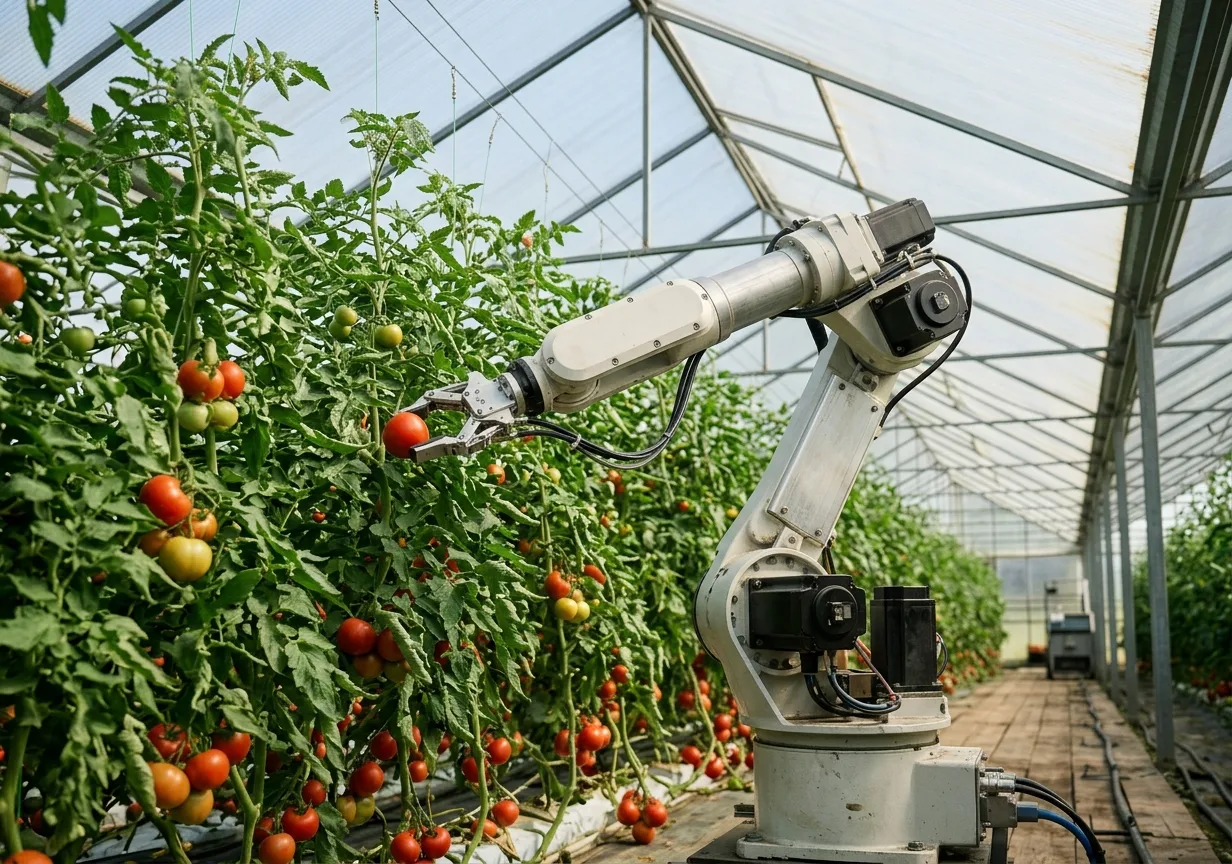
Take a stroll through California’s Central Valley; Southern Spain’s vegetable patch of Europe; or rural Japan’s rice fields. Something will look weirdly out of place. Regardless of where you wander, chances are you will struggle to find what you’re looking for: people. Instead of rows of crops teeming with diligent workers, there will be robots on wheels silently drifting through the produce. Buzzing drones with high-resolution hyperspectral cameras will monitor plant health from above. Artificial intelligence will be making split-second, informed decisions that even decades ago required generations of farming know-how to perfect. Something big is happening in agriculture. There’s a labour crisis. For years, farmers have grumbled about the lack of hands to harvest alongside them. Now the problem has ballooned to 2.4 million vacant positions annually worldwide. But this isn’t quite the human-versus-machine story you might think. Across the food system, automation has the potential to solve some of agriculture’s most pressing problems. But not without serious tradeoffs. Which is why it’s critical we understand what’s at stake as agriculture embraces a new technological revolution. From robotic harvesting arms to the migrant farmworkers who stand to lose their jobs, here’s what you need to know about the mechanization of agriculture.
The Global Agricultural Labour Shortage Driving Farm Automation
The scale of agricultural automation technology is best appreciated when set against the crisis it aims to solve. Agricultural labour shortages aren't expected to resolve themselves any time soon they are instead symptomatic of structural demographic, economic and social forces that have been years in the making. For decades young people in developed countries have left the countryside for cities, reluctant to take up work perceived to be back-breaking, low paid and with little future. In emerging markets entire agricultural communities are losing their labour forces to urbanisation. Climate volatility further compounds these issues: disrupting growing cycles and worsening farmer uncertainty year on year.
How Agricultural Robots Are Transforming Food Production
Agricultural robotics is advancing into this vacuum at pace. Farmers can now access automation solutions that span every stage of the food production process. Tomato robots with vision-systems can now spot ripe tomatoes more reliably than weary human harvesters.
Robot weeders can identify crops from weeds using AI, removing unwanted plants using a laser or precision mechanical arm blade all without the need for herbicide. Drones can map acres of cropland within hours using hyperspectral imaging, producing algorithms that alert farmers to crop stress, nutrient deficiencies and disease long before they become visible to the human eye.
The Future of Farming in Developed Countries
What's becoming clear is that agricultural automation won't just supplement human labour where shortages are worst it will wholly transform how we produce food, beginning with countries where most agricultural technology is developed: rich countries.
The Human Cost of Agricultural Automation
Human lives. Behind every conveniently-digestible stat about farm labour shortages are actual human beings seasonal workers; migrant labourers; smallholder families for whom farming isn’t a job, but an identity who stand to be disrupted, replaced, or otherwise disadvantaged by agricultural robots. Talking about robots taking human jobs isn’t naïve, morally-high-and-mighty hand-wringing. It’s asking tough questions about equity and respect and who benefits from tech not someday, but today.
Farmworkers, Rural Communities, and Job Displacement
Are we willing to ignore the plight of roughly 450 million agricultural workers across the globe primarily based in lower-income countries who depend on farm work not as a career, but as a means of survival? When wealthy-country agribusiness pushes for rapid automation, there’s a human cost at stake. Agricultural workers displaced by robots will not be able to simply upskill and join the service economy like so many manufacturing workers were promised a few decades ago.
Corporate Consolidation and Data Ownership in Smart Agriculture
Rural towns don’t have the same access to retraining programs or new industries as cities do. Plus, there’s the issue of corporate consolidation. Big Ag has always been dominated by corporations with too much power. At this point, a small number of technology companies are poised to own almost every part of the agricultural robotics supply chain. And as with all technology, agricultural robots come with strings attached. The data collected by robots about everything from soil sensors to machine learning algorithms will belong to someone.
Humans and Robots Working Together on Modern Farms
Human versus robot is perhaps too simple of a framing when discussing farm labour because it masks the far richer reality that will likely play out. While robots will certainly replace some farm jobs, farms that have begun to incorporate robots into their workforces have not entirely done away with humans.
New Agricultural Technology Jobs Emerging in Rural Economies
Instead, farms have struck a partnership between human and robot labour that is at least for now more akin to digital masterbotDictatorship than cooperation. Robots still need humans to tend to them. Farms deploying robotics still need workers to maintain those machines.
That strawberry robot may be more reliable than your average human farmworker when it comes to working 12 hours straight, but who is programming that robot to see the strawberries?
Denmark's Model for Responsible Farm Automation
The jobs will change, and we’re already seeing an emergence of jobs like robot tender, precision ag data input clerk, and agriculture-specific tech maintenance personnel. But will farmworkers be able to obtain these jobs? Probably not. Countries like Denmark have led the charge when it comes to including workers in their plans for automated agriculture.
Denmark has agreements between agricultural businesses and unions that allow robots to be introduced to the workforce, but with provisions that include retraining and wage protections for workers.
The Economics of Agricultural Robotics
The economics of automation make sense from one perspective, but not another. From the perspective of agtech companies and commercial growers at the top of the ag food chain, they make a lot of sense. Robots don’t need to sleep, they don’t get tired, and they don’t need health insurance.
Why Investors Are Betting on AgTech and Farm Automation
Wages are the largest cost of production for labor intensive crops like strawberries, blueberries, and asparagus, where picking can account for 60-70% of the growers costs.
Reduce the cost of picking by even a small amount through partial automation and the profit margins open right back up. From an investor standpoint, ag robotics has emerged as one of the most attractive segments of the entire tech industry.
The Impact of Automation on Rural Economies
But if we step back and view agriculture at the macro-economic level, the economics of automation don’t make sense. Farm jobs pay wages that support rural economies. When we automate (or consolidate or disrupt) those jobs away, restaurants close, schools see declines in enrollment, tax bases contract, and social services struggle to keep up.
Barriers to Widespread Adoption of Agricultural Robots
Existing agriculture robots generally see limited adoption due to numerous structural, social, and technological barriers. Technological challenges for robotic agriculture include issues with robustness. Farms and fields are incredibly diverse, with vast differences between farms let alone within one field throughout one growing season.
Cost, Technology, and Accessibility Challenges in Precision Agriculture
Developing robots to work reliably in these conditions at a low cost remains a key engineering challenge. Cost is another large barrier to entry. The total cost of using a robotic farming system can be too expensive for smaller farms to justify the ROI.
Climate Change and the Opportunity for Precision Agriculture
The opportunity side of the equation is large, however. Climate change will demand agriculture that can operate reliably in higher temperatures, with less water, and in the face of unpredictable weather events all things that robotic precision agriculture can help provide.
How Agricultural Automation Can Improve Sustainability
It might also be argued that the best-case vision for agricultural automation has little to do with solving labour shortages at all. Consider the environment. Agriculture is responsible for around 26% of global greenhouse gas emissions, 70% of freshwater withdrawals and is the primary cause of biodiversity loss on the planet via land-use change and pesticide spraying.
Precision Farming, Water Savings, and Reduced Pesticide Use
Precision agriculture presents the opportunity for a step-function change. Plant every seed in the optimal location with the help of GPS, deliver water to crops with AI-enabled irrigation systems that limit evaporation losses, and spray pesticides only on the plants that need it with the help of computer vision, and you reduce your environmental impact significantly.
Regenerative Agriculture and Robotics
Field trails with precision agriculture equipment in Europe and North America have already demonstrated consistently between 30–50% savings in water, 40–70% less synthetic fertiliser and up to 90% fewer pesticides used when compared with traditional farming.
Robots also unlock the economic feasibility of regenerative agricultural practices like robotic soil aeration, seeding and maintaining cover crops and biodiversity corridors.
The Future of Farming in the Age of Agricultural Automation
Farmbots rushing into fields across the globe are neither inevitability nor panacea. They are a technology immensely powerful technology whose effects on farming communities and food systems will depend entirely on how human society chooses to build, use, and regulate them.
Can Robot Farmers Create a Better Food System?
Automation is being propelled forward by a very real need to close a gap of 2.4 million labourers each year. But just because hungry people need to be fed, and farms need workers to feed them, doesn’t mean that corporations rule the future of farming. The bright futures we can imagine for automated agriculture are ones in which robots are a great leveler – allowing family farmers to access the same efficiencies and precision that large agribusinesses enjoy today, liberating farmworkers from backbreaking and dangerous labour, and enabling regenerative agriculture on a global scale.