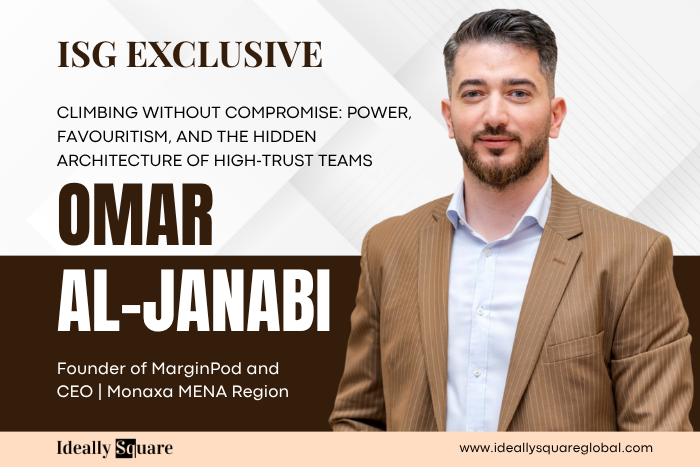
Omar Al Janabi: Climbing Without Compromise: Power, Favouritism, and the Hidden Architecture of High Trust Teams
In every organization, power changes the room before it changes the title. Omar Al Janabi explores how leaders can navigate favouritism, politics, trust, culture, and influence while preserving integrity and building organizations that thrive beyond individual leadership.
In every organization, power changes the room before it changes the title. Faces straighten, language softens, and information starts travelling through quieter, more careful channels. People are not suddenly less intelligent or less ambitious; they are simply more aware that the person in front of them can now influence their future.
From that moment on, a leader is no longer judged only by strategy or results, but by something harder to measure: how they handle the invisible consequences of authority-favouritism, politics, mixed motives, and the temptation to bend rules for those who smile the right way. The higher the position, the easier it becomes to confuse personal loyalty with performance, to reward proximity instead of merit, and to believe that silence means alignment.
Over more than a decade working across the MENA region -including my current role as CEO at Monaxa MENA and as founder of MarginPod, a podcast that draws in voices from across the trading ecosystem-I have seen the same patterns repeat in very different settings. Titles changed, sectors varied, cultures shifted, but the underlying challenge remained constant: is it possible to climb without compromising the very integrity that makes leadership worth following?
This article is an attempt to answer that question in practical terms. It is not a memoir and not a theory exercise. It is a field guide to the recurring forces around power-flattery, favouritism, hidden agendas, underestimated talent, and cultural toxicity-and to the systems that can keep a leader honest when good intentions are no longer enough.
The Theatre of Niceness: What Power Does to a Room
When authority walks in, honesty often walks out. People begin to weigh their words more carefully, not because they have less to say, but because the cost of saying it has changed. Meetings that were once full of debate can quietly turn into performances.
This is the Theatre of Niceness. Its core rule is simple: make the leader feel comfortable. It shows up in many cultures. In Arabic there is a proverb: “The hand you cannot break, kiss it and pray for it to break.” The message is not about respect; it is about survival. When power feels unchallengeable, politeness becomes a shield.
Left unchecked, the Theatre of Niceness distorts three vital things:
• Risk perception – Problems arrive late and sugar coated, disguised in optimistic language.
• Self awareness – Leaders start to believe they are more correct and more inspiring than they actually are, because dissent has been edited out.
• Talent signals – Those best at telling the truth fade into the background; those best at performing alignment move to the centre.
Breaking the theatre requires intentional design, not just a request to “be honest with me.” Some practical interventions include:
• Starting key meetings with the question: “What is the most uncomfortable thing we need to talk about today?”
• Asking junior or less powerful voices to speak first, before senior figures shape the narrative.
• Using anonymous pulse surveys or confidential feedback channels so that people can test whether the system truly protects truth telling.
In one regional team review, we institutionalised a simple ritual: every month began with a “failure debrief” led by rotating staff, not only managers. Over time, that slot became the most valuable fifteen minutes of the meeting. Once the behaviour was normalised, people stopped performing perfection and started performing learning.
Leading Without Favouritism in a World Built on Favour
Across centuries, courts, companies, and campaigns have all wrestled with the same quiet threat: favourites. They appear in many forms-family members, long time friends, early believers, charismatic high performers, or people with personal or romantic proximity to power.
Favouritism does not always arrive as corruption. It often arrives as gratitude: “This person stood by me early; I owe them.” But when gratitude becomes a permanent shortcut around standards, the message to the organisation is clear: rules are optional for those close enough to the leader.
Modern leadership research shows that perceived unfairness is one of the fastest ways to erode engagement and encourage political behaviour. When people suspect that opportunities are distributed through invisible channels, they redirect energy away from improving their work toward improving their access. Over time, the organisation stops optimising for performance and starts optimising for proximity.
Avoiding this requires more than personal resolve. It demands anti favouritism architecture built into the way decisions are made:
1. Codified criteria
Hiring, promotion, and major rewards are tied to published criteria that combine results and behaviour. If a decision cannot be defended against those criteria, it should be revisited.
2. Collective judgement
No single person, including the CEO, decides alone on promotions or major raises. Panels, calibration meetings, and 360 style inputs distribute power and dilute personal bias.
3. Rotated visibility
Access to strategic projects, executive meetings, and external representation is rotated based on transparent rules, rather than being informally assigned to an inner circle.
4. Non negotiable boundaries
Personal relationships-friendship, family ties, or any form of attraction-are openly acknowledged as conflicts of interest when relevant, and handled through recusal or shared decision making.
Throughout my own journey, there have been moments when the easiest route would have been to give a close ally special treatment, or to allow a blurred line to remain unspoken because it was flattering. Every time I chose the more difficult path-stepping back, handing a decision to a group, or saying a direct “no”-it felt uncomfortable in the moment. But each time, trust in the system grew. People pay more attention to how leaders treat their favourites than to how they treat their critics.
Power, Gender, and Mixed Motives: Designing Safe Proximity
In multi gender teams, motives around leadership can be layered. Some people approach power seeking mentorship, some seeking protection, some seeking faster advancement, and a few seeking leverage. Often, these motives coexist in the same person.
This reality does not mean leaders must become distant or suspicious. It means they must design Safe Proximity Protocols: ways of working that allow genuine connection and development without drifting into ambiguity or risk.
Key principles include:
• Public purpose for private time
One to one conversations, especially recurring ones, should have a clear, documented purpose-coaching, performance review, or specific project work-and be connected to visible outcomes.
• Programmed mentoring
Rather than “secret” mentorship, organisations can run structured programs where participants and pairings are known, timelines are defined, and results are discussed openly.
• Dual anchors for careers
No employee’s trajectory should depend solely on a single senior figure. At least two leaders should have visibility into an individual’s growth, reducing the potential for coercion or the perception of it.
In practice, these protocols protect both sides. When roles, expectations, and decision paths are clear, fewer people feel they must negotiate their worth through personal closeness. When opportunities are reviewed by more than one leader, pressure and manipulation find fewer places to attach. Leaders remain human and accessible-but within a structure that resists misinterpretation.
The Trust Vector: A Simple Mathematics for People Decisions
Stories like clear villains and obvious heroes. Real teams offer mostly gradients. Many of the hardest calls leaders face involve decent people delivering inconsistent results, or strong performers whose behaviour undermines the culture.
To avoid making decisions purely on emotion or recency, it helps to apply a simple model.
I use what I call the Trust Vector, built on three axes:
1. Performance – What is the quality and consistency of their contribution?
2. Attitude – How do they handle feedback, pressure, and collaboration?
3. Learning Velocity – How quickly do they integrate lessons and stop repeating the same mistakes?
Plotted mentally or formally, this vector reveals patterns:
• High performance, low attitude, low learning speed – short term asset, long term liability.
• Modest performance, strong attitude, high learning speed – strong candidate for investment.
• Low on all three – a mismatch for the role or even the organisation.
Second chances become clearer through this lens. When someone shows genuine improvement across the vector after feedback, betting on them again is rational, not sentimental. When the vector remains flat, repeated chances are less a gift to the person and more a burden on the team.
Some of the most painful leadership moments involve ending relationships with people who once did great work, but whose vector has moved in the wrong direction. Yet in every case where I delayed the decision to avoid discomfort, the cost to morale and trust increased. The Trust Vector does not make the choice easy; it makes it honest.
Betting on the Black Horse: A Talent Thesis
Toxicity rarely appears as a single dramatic event. It accumulates like dust: a sexist joke ignored here, a rule bent there, a high performer excused “just this once,” a complaint redirected instead of addressed. By the time leaders can see it clearly, many people have already adapted-or left.
To counter this, culture needs structural defences.
One useful model is the Transparency Triangle, composed of three kinds of clarity:
1. Clarity of Standards
Behavioural and performance expectations are explicit and lived. People can predict which actions will be rewarded and which will not, regardless of who does them.
2. Clarity of Process
There are known ways to raise issues, appeal decisions, and resolve conflicts. Processes are not hidden; they are communicated and practiced.
3. Clarity of Consequence
Similar violations lead to similar responses. A senior producer who crosses a line faces the same principles as a new hire. This is where most cultures fail-and where trust is either built or broken.
In one case, we made the decision to end collaboration with a partner whose numbers were strong but whose treatment of others repeatedly breached our standards. Financially, the short term impact was noticeable. Culturally, the long term effect was transformative: people realised the rules applied upwards as well as downwards. Informal politics lost some of its power because formal principles had finally been tested in public.
Toxic resistant cultures are not perfect, but they are predictable in the right ways. People may disagree with outcomes, but they do not feel blindsided by them.
Beyond the Office: Leadership as Community Infrastructure
Today, leadership reputations are shaped as much in public as in private. Podcasts, webinars, open Q&As, and social channels have become extensions of the office, carrying a leader’s voice into communities that may never see an internal memo.
MarginPod began as a project to make trading conversations more honest in Arabic-bringing in market veterans, risk experts, and everyday traders to discuss not only strategies but also the emotions and mistakes that sit behind the numbers. Over time, it turned into something broader: a space where transparency, challenge, and learning were normalised in a region where many had become wary of “official” narratives.
This experience reinforced a simple lesson: an organisation is only as trusted as the community spaces around it. When leaders routinely show up in those spaces with the same principles they claim internally-clarity, fairness, and a willingness to confront uncomfortable truths-they extend their culture beyond their payroll. Future employees, partners, and clients often encounter this “outer culture” first; by the time they join formally, they already know what to expect.
Climbing Without Compromise
Ambition is not the enemy. Without it, no one would build companies, teams, or new markets. The real question is what is quietly traded away along the climb: fairness for loyalty, truth for comfort, long term trust for short term wins.
Climbing without compromise does not mean avoiding all mistakes. It means refusing to let position become a licence for exceptions. It means designing systems that protect others from your blind spots and protect you from your own power.
Practically, it looks like this:
• Refusing to let the Theatre of Niceness become your only source of information.
• Embedding anti favouritism architecture so that even your favourites cannot bypass standards.
• Applying Safe Proximity Protocols to keep multi gender, multi motive teams both human and safe.
• Using the Trust Vector to make people decisions that are firm, fair, and explainable.
• Betting intentionally on black horses instead of recycling the same profiles.
• Guarding the Transparency Triangle so that culture can withstand pressure.
• Treating public platforms and communities as part of the leadership role, not a side hobby.
In the end, the leaders who leave the deepest mark are not those who climbed fastest, but those whose teams, partners, and communities can still thrive long after their name disappears from the organisation chart. Their legacy is not a position, but a pattern-a way of handling power that others can study, replicate, and build on. That, more than any title, is what makes a career worth writing about.
Read the full issue
Open Magazine →