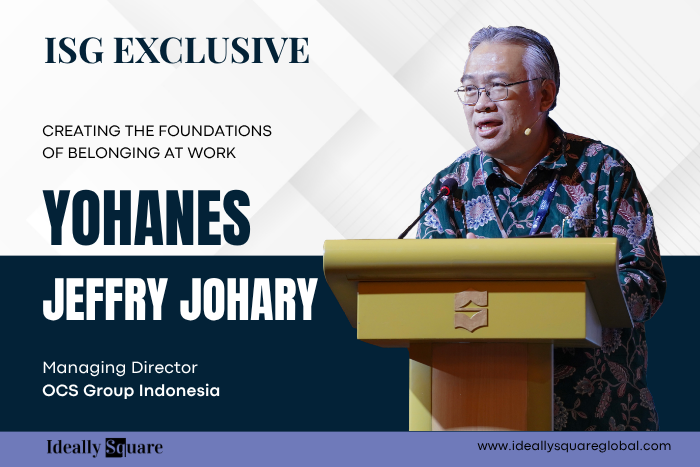
Yohanes Jeffry Johary: Global Strategic Business Leaders 2026
Workplaces have begun to shape more than just how work gets done. They influence how people feel when they walk in, how confidently they engage, and how fully they can contribute. Under Yohanes Jeffry Johary's leadership at OCS Group Indonesia, workplace environments are treated as systems that influence outcomes rather than assets that require upkeep.
The Workplace as a Human System
Light, air, order, and responsiveness are no longer background details. They shape clarity of thought, reinforce a sense of safety, and determine whether people feel supported or strained through the course of a day. Culture is not only built through leadership or policy, it is also experienced in every corner of a workplace. In that sense, the workplace has become deeply human, carrying the weight of productivity, well-being, and belonging all at once.
Rethinking the Foundations of Facility Management
There was a time when Jeffry would describe facility management in straightforward operational terms. It was a discipline centered on maintaining buildings, ensuring service delivery, and meeting contractual obligations. Success was measured by response times, adherence to service level agreements, and the ability to operate efficiently within cost constraints. At OCS Group Indonesia, this traditional framework served as the foundation of operations. The organization functioned as a disciplined facility management provider, focused on execution and operational performance. Teams were deployed across hundreds of sites, systems were aligned with service delivery objectives, and performance was evaluated strictly against contractual commitments. It was a structured and effective model that fulfilled its purpose in a stable environment. However, as Jeffry observed over time, facility management could no longer remain confined to its traditional identity as a support function. It began evolving into something far more integral: a system through which organizations execute sustainability strategies, workforce development, and long-term resilience.
Uncovering the Limits of Efficiency-Driven Models
As operations expanded, Jeffry began to notice subtle but significant shifts. Clients were no longer satisfied with simply knowing whether services were delivered. Their expectations evolved. They began asking deeper questions about how facility management contributed to broader organizational priorities. Sustainability, workforce well-being, and long-term resilience emerged as central themes. At the same time, the internal complexity of managing a workforce of over thirteen thousand employees across diverse sites became increasingly apparent. The scale itself revealed systemic tensions that could not be resolved through efficiency alone. In a labor-intensive industry like facility management, efficiency has traditionally been pursued with discipline. Processes are optimized, costs are tightly controlled, and performance is monitored rigorously. This approach remains essential, particularly in competitive markets. Yet, as Jeffry recognized, it also has limitations. Efforts to reduce costs often resulted in increased pressure on the workforce. Supplier relationships became more transactional as margins tightened. Sustainability initiatives, when not embedded into daily operations, were reduced to compliance exercises rather than drivers of meaningful change. The structural realities of the industry further compounded these challenges. Labor accounts for approximately seventy to eighty percent of contract value, while client payment cycles can extend from thirty to one hundred and fifty days. Under such conditions, decisions in procurement, workforce allocation, and cash flow management carry consequences that ripple across the entire system. These were not isolated inefficiencies. They were signals pointing to deeper systemic limitations. Efficiency alone could optimize individual components, but it failed to capture the broader interdependencies within the system. Over time, this created a disconnect between what was measured and what truly mattered. Jeffry realized that what was missing was not greater control, but better anticipation. This insight marked the beginning of a fundamental shift in perspective.
Rethinking the Role of Facility Management
The transformation did not begin with a predefined model. It began with a different question. Instead of asking how services could be delivered more efficiently, Jeffry and his team began exploring what role facility management plays in the overall performance of an organization. The answer extended beyond contracts and service scopes. It lay in understanding how facilities influence people, operations, and outcomes on a daily basis. A workplace is more than a physical space. It is where productivity is shaped, safety is ensured, and organizational culture becomes visible. It is the environment where strategic intent is translated into operational reality. Facility management operates at the intersection of these dynamics, making it a critical enabler of performance. This shift in perspective fundamentally changed how Jeffry approached the function. Buildings were no longer seen merely as assets to be maintained. Instead, workplaces were understood as environments that actively shape human behavior and organizational outcomes. Service delivery remained essential, but it was no longer the ultimate objective. The focus expanded toward enabling outcomes that extend beyond contractual obligations. This required a redefinition of how the organization itself operates.
The Journey Toward Regenerative Facility Management
The transformation toward a regenerative model unfolded over several years. It was shaped by both internal priorities and evolving external expectations. The first phase focused on digitalization. Jeffry led efforts to integrate operational, financial, and workforce systems to enhance visibility across the organization. Previously, data often arrived too late to support timely decision-making. With integrated systems, the organization gained near real-time insights, enabling earlier and more informed decisions. The second phase centered on sustainability. Initially treated as a compliance requirement or reporting function, sustainability began to take on a more strategic role. Jeffry recognized that its true impact depends on how deeply it is embedded into daily operations. Environmental and social considerations were therefore integrated into routine practices, influencing resource management and supplier engagement. The third phase addressed workforce development. Managing a large and distributed workforce highlighted the importance of capability as a driver of operational quality. Jeffry repositioned workforce development as a core operational priority. Structured pathways were introduced to enhance skills, create progression opportunities, and ensure that employee capabilities evolved alongside organizational needs. Through these phases, facility management began to be understood not as a collection of services, but as a system that supports and shapes organizational performance. This evolution laid the foundation for a new concept: regeneration.
The Power of Regenerative Systems
For Jeffry, regeneration represents a model in which different components of the organization reinforce and strengthen one another over time. It is a shift from linear efficiency to interconnected value creation. This perspective brings four key elements into focus: people, community, workplace, and the natural environment. The workforce is no longer viewed solely as a resource but as a dynamic source of capability that requires continuous development. Community engagement is recognized as a contributor to operational stability, acknowledging that local environments influence long-term performance. The workplace is managed as an active environment that shapes productivity, safety, and employee experience. Environmental considerations are integrated into everyday practices, ensuring responsible resource use and waste management. These elements are deeply interconnected. Improvements in one area influence outcomes in others. Over time, this interconnectedness creates a more stable, adaptive, and resilient operating system. Jeffry also recognizes that this shift is not unique to facility management. It reflects a broader transformation across labor-intensive industries, where value is increasingly created through alignment between workforce capability, operational discipline, and sustainability. Organizations that fail to embrace this shift risk optimizing isolated components while the overall system becomes fragile.
Embedding Compliance, Resilience and Presilience
As the model evolved, Jeffry identified the need for a system capable of not only responding to disruption but also anticipating it. This led to the integration of three critical concepts: compliance, resilience, and presilience. Compliance establishes the baseline by ensuring that operations meet defined standards. Resilience reflects the ability to continue functioning under stress. While both are essential, they are inherently reactive. Presilience introduces a forward-looking dimension. It focuses on anticipating disruptions before they become visible. It is grounded in risk intelligence, which involves interpreting weak signals, identifying emerging patterns, and making decisions with incomplete information. In practice, this approach transforms decision-making across the organization. Workforce development becomes proactive, anticipating future skill requirements. Community engagement strengthens long-term operational stability. Workplace management incorporates early detection of vulnerabilities. Environmental practices shift from compliance to proactive resource management. Jeffry emphasizes that this requires a different leadership mindset. Decisions must be made under uncertainty, balancing experience, current insights, and future possibilities. The ability to act without complete information becomes a defining capability. Over time, this approach builds an organization that not only recovers from disruption but also actively shapes the conditions in which it operates.
Integrating Value Across Every Dimension
As these changes took root, they influenced how Jeffry viewed the organization itself. While commercial discipline remains fundamental, the outcomes of the transformation extend beyond financial performance. Workforce development creates opportunities for growth and progression. Environmental initiatives enhance sustainability. Strong governance builds trust with clients and stakeholders. These outcomes are not separate from business performance; they are embedded within it. This realization led Jeffry to define OCS Indonesia as a hybrid enterprise. It is an organization that maintains commercial rigor while integrating social and environmental considerations into its core operations. This model introduces greater complexity in decision-making. Every decision carries implications across multiple dimensions. However, it also creates a more balanced and sustainable operating framework.
Execution Is the True Test of Strategy
One of the most important lessons from this journey is that transformation is not defined by strategy alone, but by execution. Articulating direction is relatively straightforward. Ensuring that it is consistently reflected in day-to-day operations is significantly more challenging. On the operational level, decisions are undertaken continuously by procurement, scheduling, and routine activities. When these decisions do not coincide, the general strategy becomes disjointed. It must be implemented, however, not just consistently, but conscious of the wider implications. To reinforce this, Jeffry has highlighted the need to empower systems. Operational visibility is strengthened through integrated systems, enabling clearer accountability and more consistent decision-making. The development of capabilities empowers the workers to make wise judgments. These mechanisms enable the organization to be coherent despite the growth and transformation that the organization undergoes. In practice, decisions are made under real constraints, where cost, workforce, and compliance must be balanced without compromising long-term integrity.
Adapting Systems for a Diverse Operating Reality
There are opportunities and threats of operating in Indonesia. The size and diversity of the country generate diverse operating conditions that must be flexible. Jeffry has concentrated on consistency and flexibility. The major principles are held throughout the organization, and the local contexts are modified in operation practices. The strategy provides consistency and responsiveness to particular issues. It also supports the need to develop systems that are resilient enough to operate effectively in a wide range of environments.
Read the full issue
Open Magazine →