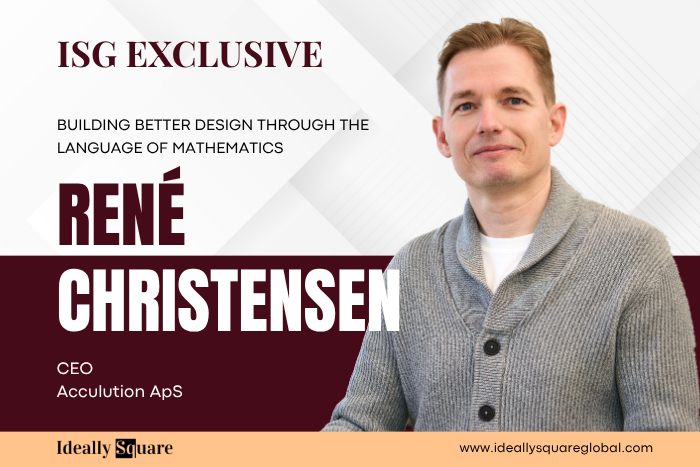
René Christensen: Global Simulation & Acoustic Engineering Leaders 2026
Before a product is ever held in the hand, heard in a room, or tested in motion, it first exists in a quieter space, one shaped by equations, assumptions, and possibilities. This is where engineering moves beyond mechanics and enters the realm of foresight. The most transformative breakthroughs are often born not on the production floor, but within the invisible architecture of mathematics, simulation, and scientific imagination.
Where Curiosity First Found Its Frequency
René’s early years were shaped by curiosity rather than a clearly defined path. Coming from a working-class family, there was no predetermined roadmap for education or career, and his aspirations shifted across a range of possibilities. At different moments, he imagined becoming a veterinarian, an electrician, and even a pilot. These ideas, however, were not rooted in lived experiences or a strong sense of calling. What truly sparked his intellectual imagination was something far more unexpected: the Danish HiFi magazine HiFi & Elektronik that he discovered in his school library. Within its pages, René found a fascination with electronics and loudspeakers, an interest that would later influence the educational and professional choices that defined his life’s work. What began as an early attraction to sound, circuitry, and technology gradually evolved into the foundation of a remarkable career in engineering, acoustics, and mathematical modelling.
The Foundations of a Future Innovator
After completing public school, René enrolled in a newly established technical high school with a strong focus on industrial disciplines. For him, electronics became the obvious specialization, aligning naturally with the interests that had begun to take shape in his formative years. This was followed by a period in the military, where an education and career advisor suggested engineering as a serious path forward. Soon after completing his service, René enrolled in a bachelor’s degree in Electrical Engineering. His academic focus was strongly centered on signal processing, a field that remains central to his work today. As he progressed through the later semesters, his attention began to shift toward acoustics. This growing interest culminated in a final project in room acoustics undertaken alongside his friend Rune. Although job prospects were favorable after completing his bachelor’s degree, René felt there was still something missing intellectually. When Rune proposed enrolling in a newly established master’s programme in Physics and Technology, René decided to continue his academic journey. While his friend eventually withdrew, René remained committed and completed his MSc, specializing in numerical acoustics with a focus on the Boundary Element Method. This marked a major turning point, deepening his expertise in the mathematical and physical principles that would later define his professional identity.
The First Chapter of Professional Discovery
The job market had become more challenging by the time René completed his master’s degree. Nevertheless, he began his career by teaching acoustics and optics at the same engineering college and university where he had studied. This experience opened his mind to the possibility of an academic career and allowed him to explore the joy of teaching complex scientific concepts. During this period, however, he was offered a role at DELTA, a well-known technology and consulting firm in Denmark. He joined the Machine Acoustics department, where he became involved in highly collaborative projects with major Danish companies such as Danfoss and Grundfos, as well as Aalborg University. These years provided René with valuable exposure to industrial applications of acoustics and consulting work at a high level. Yet as the large collaborative projects eventually concluded, the work began to feel less intellectually stimulating. Recognizing the need for a new challenge, he began looking for a path that would push him further.
Where Research Found Its Purpose
That new challenge emerged in the form of a PhD opportunity. René’s former MSc supervisor was in the process of launching a doctoral project, and shortly afterward, René left his role to pursue a PhD in Applied Mathematical Modelling with a focus on microacoustics. This was undertaken as an Industrial PhD in collaboration with the renowned Danish hearing aid company. The experience brought a new level of academic rigor and intellectual growth. Publishing research papers, engaging with complex mathematical frameworks, and spending three months at the National Research Council in Canada significantly broadened both his research capabilities and global perspective. This period strengthened René’s ability to bridge theoretical science with real-world industrial challenges, a balance that would later become the hallmark of his company.
Where Discipline Was Forged Through Speed and Precision
After completing his PhD, René joined the Danish consulting company iCapture, founded by Ulrik Skov. For much of his time there, the company consisted of only the two of them, and this highly focused environment fundamentally transformed René’s approach to work. Unlike larger organizations, where processes often move according to the pace of multiple teams and layers of coordination, consulting within a small company demanded speed, precision, and consistently high-quality output. He learned to complete tasks as efficiently as possible while maintaining exceptional standards, knowing that client satisfaction depended directly on the quality and reliability of results delivered. This intense and high-tempo consulting environment deeply shaped his professional discipline and instilled in him a mindset centered on both excellence and efficiency. A very short stint at the Danish loudspeaker company Dynaudio further clarified his professional direction. That experience reinforced the realization that working solely within a loudspeaker company no longer felt sufficiently challenging from an intellectual standpoint. He later joined GN Hearing, where his role expanded well beyond acoustics into structural mechanics and electromagnetics. Here, the pace of work often depended on information bottlenecks across different teams, and because René frequently completed tasks quickly, he often found himself with valuable time for independent research and deeper exploration. It was during this phase that the seeds were planted for what would become the next defining chapter of his journey, the creation of his own platform for research, insight, and eventually entrepreneurship.
When Knowledge Became a Voice
Rene created Acculution.com, the blog, in 2017 and dedicated most of his time to personal research and insights to share it with a wider audience. The blog turned out to be a platform through which he posted about in-depth technical knowledge of signal processing, vibroacoustics, optimization, and mathematical modelling. His intention was not simply to train engineers in related disciplines but also to instill a more stringent and systematic style of engineering problem solving. At this initial phase, René saw the potential of this platform becoming a complete company. Even though he had originally calculated that this transition would take eight years, things were happening much quicker than anticipated.
The Leap That Became a Legacy
Rene took the final jump in 2021. He resigned and started his own consulting and research firm, Acculution ApS in Denmark. Luckily, his blogging years had already earned him credibility and visibility. A number of companies had tracked his work online and directly called him, inquiring whether he would be willing to become a consultant in their ongoing projects. This implied that René could start with a ready client base as opposed to cold calls. Since its inception, Acculution had primarily focused on international clients. Early projects involved sophisticated modelling of composite materials, loudspeaker transducers, and electrostatic headphones. René further increased his reputation in 2022 when audioXpress commissioned him to write in the industry magazine due to the quality of his published work on the blog. He has since published many articles, which have further established his authority in the international engineering and acoustics circles.
The Power of Modelling Before Creation
Mathematical modelling is one of the greatest pillars of René’s work. To him, the fact that he can create the right models of physical systems even before there is a physical model is a huge strength in engineering design. It enables companies to make wise decisions concerning geometry, materials, and performance much earlier in the development cycle, saving time and cost. René feels that, as much as simulation software is powerful, it is over-relied on by many engineers as a trial-and-error tool. To him, the real worth is not in the running of simulations, but in knowing the mathematics and physics behind them. He often points out that software is not able to tell whether a model is really a true reflection of the physical system under investigation. It requires profound scientific knowledge, imagination, and the ability and bravery to pose unorthodox what-if questions. To René, to be at the top level, it takes more than just software expertise. It requires organization, mathematical insight, and an analytical attitude that can make a division between modelling, analysis, synthesis, and optimization.
Pushing Boundaries Through Optimization
Optimization is one of the most important fields of specialization of René. During the past 10 years, he has followed and contributed to the field of acoustical topology optimization, a sophisticated area where a design domain is subdivided into smaller structures, which may either be air that transmits sound or reflective solid material. The system is optimized through gradient-based optimization techniques, which gradually progress the system to achieve predetermined aural performance goals. One contribution from René to the field was coming up with what was first published acoustical topology optimization scheme to incorporate microacoustics effects in 2017, drawing on knowledge from his PhD research. René has used various optimization techniques in the design of a number of real-world products, in conjunction with clients. The most prominent are loudspeaker products released in 2023, which had their most pivotal parts created entirely by using acoustical topology optimization in Acculution, which René considers to be the first products ever made via this specific process.
A Future Built on Possibility
Today, René finds himself in a remarkable position. He works on his own projects outside of Denmark, and at the same time works on many international client projects, research projects, and industry publications. His knowledge is now in demand to an extent that can hardly be handled by an individual. The significance of this moment is that all the key aspirations he initially had for the company are already fulfilled in the span of only five years. The first direction is to keep on expanding Acculution as it is now, broadening the client base and strengthening the existing partnerships. The other option is to become the head of a research team or acquire a key scientific position in a bigger organization where one can have the freedom to conduct research and solve industrial problems. But René is keenly conscious that he is not going to find much to repeat the freedom and intellectual vigour with which he is now living. His involvement with a variety of companies and a variety of technical issues keeps him constantly active and mentally acute in a manner that a single product or organization may not. As of today, René is deeply appreciative of what he gets to wake up to every morning and the clients who are still making this journey a reality. This is the tale of an inquisitive mind turned into knowledge, and knowledge turned into an impact on the world.
Read the full issue
Open Magazine →