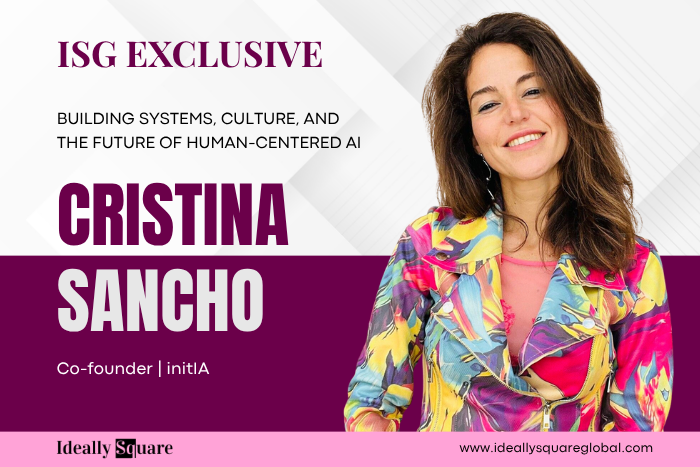
Cristina Sancho: Building Systems, Culture, and the Future of Human-Centered AI
Businesses are investing heavily in growth, innovation, and artificial intelligence, yet many continue to operate with teams burdened by repetitive tasks, fragmented workflows, and processes that were never designed for the speed and complexity of today's demands. Employees spend hours following up on invoices, verifying documents, updating systems, and moving information from one place to another. Leaders pursue transformation initiatives while underlying inefficiencies quietly absorb time, resources, and attention.
Connecting the Dots Backward
For years, Cristina believed entrepreneurship would eventually define her future. She often joked that she would not have children because she wanted to dedicate all her energy to building a business. The irony, however, was that she had no idea what that business would be. What followed was an eighteen-year journey through some of the world's most influential organizations. From Unisys and Amazon to Netflix and Taringa, Cristina accumulated experiences that appeared disconnected on the surface. Looking back, she now recognizes a common thread running through all of them. The business she was building was herself. Each company, challenge, success, and setback contributed to a leadership philosophy rooted in curiosity, human understanding, operational excellence, and meaningful transformation. The journey may have seemed indirect, but every chapter prepared her for what she does today as co-founder of initIA, an AI operations studio helping organizations transform the way they work.
The Foundations of Transformation
Cristina's career began in technology consulting with Unisys, where she spent three years working on a major process optimization project for Endesa, one of Europe's largest energy companies. Interestingly, the work mirrors much of what she does today. Then, the objective was to identify repeatable processes and improve efficiency. Now, through AI and automation, she helps organizations eliminate repetitive tasks so people can focus on higher-value activities. Yet even in those early years, technology itself was never the primary attraction. Cristina was fascinated by the impact technology could have on people, organizations, and productivity. She viewed systems not as technical structures but as mechanisms that shaped human behavior and business outcomes. That perspective would follow her throughout her career.
Inside the Machine: The Amazon Years
Seeking greater exposure to consumer-focused business, Cristina moved to Seattle to join Amazon. Few organizations operate with the intensity, precision, and scale that define Amazon. During her time there, she led global social media strategy and channels at a moment when social media was rapidly transforming how brands interacted with customers. The experience fundamentally reshaped how she thought about execution. Amazon taught her to think in systems. Every process had inputs, outputs, feedback loops, and measurable outcomes. Decisions were driven by data. Inefficiencies were viewed as design flaws waiting to be solved. The company instilled a discipline that continues to influence her thinking today. At Amazon, precision mattered, not only in operations but also in communication. Clear thinking required clear language. Every action had consequences, every process could be optimized, and every result could be measured. Years later, many of those lessons would become foundational to the way she approaches organizational transformation and AI implementation.
When Culture Becomes Competitive Advantage
Following Amazon, Cristina moved to Netflix in 2015 to help launch the platform across Southern Europe. Amazon was systems, Netflix was culture. She came at a pivotal time of growth for the company, as part of one of Netflix’s last regional launches before the landmark global launch in 2016. In the next seven years she helped grow the business to millions of subscribers before moving to the content division when Netflix opened its Madrid studios. The change offered a completely different outlook on how organizations functioned. Netflix talks a lot about culture but Cristina saw right away that they really walk the walk. Principles like Freedom and Responsibility, the Keeper Test, and Top of Market Compensation were not just concepts; they affected day-to-day decisions. More importantly, she learned culture is not defined by mission statements or values documents. Culture is in the little things. It’s in the choices people make when no one’s watching, it’s in the standards organizations set for themselves and it’s in the way leaders act when the heat is on. Being part of productions from script to screen, including global hits like Money Heist, further cemented the importance of trust, accountability and creative collaboration.
The Leadership Test Called Taringa
Cristina's next chapter would test her in very different ways. After a blockchain company bought it, she was named CEO of Taringa, Latin America’s biggest social network. This was her first time stepping into the role of chief executive, replacing a founder during a time of significant organizational change. Suddenly, leadership became less about optimization and more about stability. The company was in transition, with new owners, new priorities and no clear sense of direction. Employees need more than direction, they need confidence, clarity, and a sense of purpose. Taringa taught Cristina something that Amazon or Netflix wouldn’t have been able to teach her. Sometimes leadership isn’t about making systems more efficient. Sometimes leadership is holding an organization together in times of uncertainty and helping people find meaning when the way forward is not clear. It was an education in resilience, empathy and responsibility.
The Challenge Behind the Title
Executive biographies often focus on accomplishments while overlooking the more uncomfortable realities of leadership. Cristina openly discusses a pattern she experienced multiple times throughout her career, what she calls being "set up for success or set up for failure." These situations involved receiving the title without the necessary authority, the responsibility without sufficient support, or the expectations without the conditions required to succeed. When the inevitable challenges emerged, honest conversations were often absent. For years, she struggled to articulate why certain environments felt wrong. Eventually, she realized there was a critical distinction between a challenge that promotes growth and an environment fundamentally misaligned with who you are. The first creates productive discomfort. The second slowly erodes confidence, energy, and authenticity. Learning to recognize that difference became one of the most important leadership skills she developed.
The Human Work Behind Every Transformation
Today, Cristina describes herself as a leader driven primarily by curiosity. Whenever she enters a new environment, her first instinct is to ask a simple question: How does this actually work? That question guides everything from leadership and operations to organizational transformation. She firmly believes in what she calls 'internal work before external tools.' Before introducing new systems, technologies, or processes, leaders must understand the human dynamics operating underneath them. What are people afraid of? What are they protecting? What assumptions are shaping behavior? What must change for transformation to succeed? Without answering those questions, even the most sophisticated initiatives struggle to gain traction. Cristina also champions direct communication. Not harshness, but honesty. The leaders she respected most throughout her career were those who were willing to tell uncomfortable truths clearly and respectfully. That is the standard she now strives to uphold herself.
Rethinking AI from the Ground Up
Today, Cristina co-leads initIA, an AI operations studio focused on helping organizations identify repetitive tasks, automate workflows, and integrate AI into everyday operations. The company develops what it describes as 'employees that happen to be software' - AI-powered systems capable of handling real operational tasks at scale. Through this work, Cristina has developed a perspective that challenges many prevailing assumptions about AI implementation. She believes most AI projects fail for the same reason many organizational transformations fail: companies focus on technology before understanding the process. A broken workflow does not become better because it is automated. It simply becomes a faster broken workflow. That insight led initIA to create ARIA, the Automation Readiness Intelligent Audit. Rather than starting with software, the process begins by mapping how work is actually performed inside an organization. Teams examine where friction exists, where decisions are made, and whether a problem requires automation or simply a better conversation. Only after gaining that understanding does technology enter the equation. The results have included AI systems handling thousands of lead interactions, document verification processes reduced from hours to seconds, and administrative workflows transformed into scalable automated operations.
The Human Side of Artificial Intelligence
Despite her deep involvement in AI, Cristina believes the most important conversations surrounding technology have very little to do with technology itself. She often observes two different mindsets among business leaders. One group asks, "How can we do the same work with fewer people?" The other asks, "How much more could we achieve with our people?" The distinction matters. Cristina chooses to work with organizations that see AI as a tool for amplification rather than replacement. She believes technology should remove repetitive work so employees can focus on creativity, decision-making, relationships, and innovation. Organizations that approach AI purely as a cost-cutting exercise risk losing something far more valuable than efficiency. They risk losing institutional knowledge, human insight, and the cultural foundations that make organizations effective. For Cristina, the defining leadership question is not whether something can be automated. It is whether it should be. The Value of Being in the Right Place On the surface, Cristina’s career seems like a clear path: Amazon, Netflix, CEO, founder. She sees it another way. Her career has been a series of decisions made in the dark. Some felt fine right away. Others only made sense in hindsight. Today, she knows that context is more important than many people realize. The first question should not always be, “What is wrong with me?” if someone is consistently underperforming. Sometimes it is better to ask, “Am I in the right environment? Cristina thinks that knowing when a place no longer supports the best version of yourself is a kind of leadership in and of itself. She has left roles others told her to stay in. She has opted for personal values rather than institutional pressure. She has walked away from opportunities that on paper looked attractive but felt fundamentally misaligned. She’s never regretted those decisions.
Keeping People at the Center
As artificial intelligence continues to reshape industries, Cristina believes that future leaders will need to balance two capabilities simultaneously: operational rigor and genuine human understanding. Technology will continue to develop. Automation will become smarter. There will be new tools coming out faster and faster. But leadership will still be fundamentally human. The leaders who will succeed are the leaders who can think critically about both possibility and consequence. They will not only ask what technology can do, but what it should do. They will appreciate that governance, ethics and culture are as important as the innovation itself. Most importantly, they will remember that all change is ultimately people change. For Cristina, that realization isn’t just a leadership principle. It’s the thread that runs through every chapter of her journey, from consulting and global technology firms to entrepreneurship and artificial intelligence. The tools are different. The mission has not.
Read the full issue
Open Magazine →