Germany's Most Influential CFO's and Financial Leaders to Watch in 2026
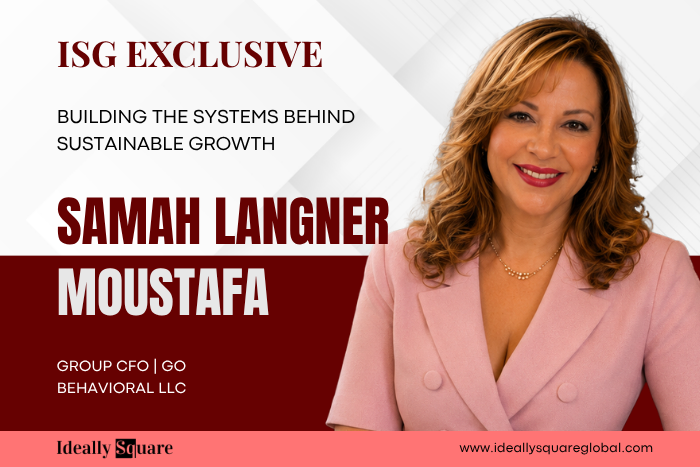
Finance is often introduced at the end of a business story, as a report of what was earned, spent, gained, or lost. Yet long before the figures settle into a balance sheet, finance is already at work: shaping the systems that support growth, testing the strength of every ambition, and revealing whether an organisation is built merely to expand or prepared to endure. The most influential financial leaders understand that numbers carry the consequences of decisions, the health of operations, and the possibilities of what can be built next. Samah Langner Moustafa brings this broader understanding to every dimension of her leadership. As Group CFO of Go Behavioral LLC, she moves beyond conventional financial management by connecting finance with operations, compliance, technology, people, and organisational development.
A Recognition Rooted in Responsibility
Recognised as one of Germany’s Most Influential CFOs & Financial Leaders to Watch in 2026, Samah represents a new generation of financial leadership, one that extends beyond numbers to influence operations, technology, organisational development, and long-term business strategy.
For Samah, the recognition carries significance both personally and professionally. It reflects a career built through resilience, discipline, continuous reinvention, and the courage to keep progressing even when the path has demanded difficult choices.
She believes leadership is not created through a single achievement. It develops gradually through years of commitment, accountability, and the ability to grow through changing circumstances. Being recognised among Germany’s influential financial leaders is particularly meaningful at a time when the CFO’s role is becoming increasingly strategic, people-focused, and closely connected to the future direction of business.
Rather than viewing the recognition simply as an acknowledgement of success, Samah considers it a responsibility. It strengthens her commitment to using finance as a foundation for structure, sustainable growth, accountability, and positive organisational impact.
A Career Built Beyond Conventional Finance
Samah began her professional journey with a strong foundation in accounting and financial control. Over more than two decades, her career expanded across finance, operations, compliance, and international business, gradually shaping a leadership perspective that reaches far beyond conventional financial management.
One of the most important lessons she learned early in her career was that numbers never exist independently. Behind every financial report are people, decisions, systems, risks, and opportunities. This understanding changed how she approached finance and encouraged her to view it as an active contributor to organisational progress.
Working across Germany and the United States became another defining chapter. Exposure to different regulations, business cultures, expectations, and operational environments expanded her perspective from managing financial performance to leading organisational transformation.
These experiences taught Samah that executive leadership requires clarity under pressure, emotional intelligence, and the ability to connect financial discipline with commercial ambition. Her journey has increasingly centred on building bridges between strategy and execution, growth and structure, and financial excellence and human impact.
Finance as the Organisational Nervous System
As Group CFO of Go Behavioral LLC, Samah’s responsibilities extend into operational strategy, human resources collaboration, payroll, employee benefits, compliance, organisational development, and scalable process design.
She views finance as the central nervous system of an organisation because every business function carries a financial implication, while every financial decision creates an operational consequence. This perspective encourages collaboration rather than separation between departments.
By connecting finance closely with operations, HR, compliance, and executive leadership, Samah helps create an organisation that is more informed, coordinated, and responsive. Her focus remains on establishing transparent workflows, accurate reporting, clear systems, and disciplined decision-making.
For her, balance is achieved through prioritisation, consistent communication, and the ability to understand the broader organisational picture without losing attention to critical details.
The Systems That Keep Growth Standing
Rapid growth creates opportunity, but it can also expose weaknesses that remain hidden within smaller organisations. In healthcare, expansion carries additional responsibilities because financial growth must remain aligned with regulatory compliance, workforce stability, quality of care, and operational sustainability.
Samah believes sustainable growth requires more than opening new locations or increasing revenue. It demands the systems and discipline necessary to ensure that expansion does not weaken the organisation internally.
Accurate data, proactive planning, clear accountability, and strong internal controls form the foundation of her approach. She recognises that minor process gaps can develop into significant risks as an organisation grows. Consequently, she prioritises building effective systems before challenges become urgent.
Budgeting, payroll accuracy, revenue-cycle awareness, benefits administration, compliance reviews, and operational reporting must function collectively rather than independently. To Samah, growth should never be uncontrolled. It should be purposeful, measurable, and supported by people who understand the organisation’s mission.
Building Systems That Outlast Individual Effort
“Numbers tell the story, but systems determine the future” is the philosophy that defines Samah’s approach to financial and operational leadership.
Managing numbers alone can become reactive, whereas building systems enables organisations to prepare for what comes next. A scalable financial infrastructure allows leaders to make informed decisions, identify risks earlier, and pursue growth with greater confidence.
Samah believes that processes should be designed to extend beyond individual effort. An organisation that depends solely on people working harder will eventually encounter limitations. Strong systems, however, allow growth to occur with consistency and resilience.
Her approach includes:
• Establishing documented and repeatable procedures
• Developing reliable financial and operational reporting
• Introducing automation where it creates meaningful value
• Creating transparent approval workflows
• Defining responsibilities and accountability
• Continuously reviewing systems as organisational needs evolve
Effective systems reduce uncertainty, improve transparency, and strengthen organisational accountability. They also provide stability during rapid expansion, regulatory change, and leadership transitions.
Discipline with the Agility to Adapt
Healthcare organisations operate within an environment shaped by changing regulations, workforce demands, payer requirements, increasing costs, and evolving service expectations. Strategic decisions must therefore combine careful evaluation with the ability to respond quickly.
Samah begins with data but ensures that decisions are not limited to financial indicators. She considers operational capacity, compliance exposure, organisational priorities, and the human impact of each decision.
Financial discipline requires a clear understanding of available resources, potential risks, and the long-term consequences of present choices. Agility, meanwhile, enables an organisation to adapt without abandoning the structures that protect its stability.
For Samah, the strongest decisions are neither driven solely by emotion nor restricted entirely to numbers. They are informed, balanced, timely, and responsible.
Connecting German Precision with American Enterprise
Working across Germany and the United States has provided Samah with valuable insight into two distinct business cultures.
Germany strengthened her appreciation for precision, documentation, regulatory discipline, structured processes, and long-term stability. The United States demonstrated the value of entrepreneurial thinking, flexibility, opportunity, rapid execution, and growth-focused decision-making.
Rather than favouring one approach, Samah draws from the strengths of both. Her leadership combines structure with adaptability and disciplined planning with the willingness to pursue new possibilities.
Cross-cultural leadership has also reinforced the importance of clear communication. Different regulatory environments and working practices can create misunderstandings when expectations remain unspoken. Leaders must therefore translate priorities, establish alignment, and create trust across teams.
Samah believes global leadership is not about imposing one method across every market. It is about establishing a shared standard of excellence while respecting local business realities.
The CFO as a Driver of Transformation
The role of the CFO is undergoing a significant transformation. Over the next decade, Samah expects financial leaders to become data strategists, technology partners, transformation leaders, and influential contributors to organisational risk management.
Automation and artificial intelligence will continue to reshape financial operations by reducing repetitive work, strengthening forecasting, improving reporting, and enabling faster analysis. However, she does not view technology as a replacement for leadership judgment.
As access to data increases, the ability to interpret information responsibly will become even more valuable. CFOs will need to understand technology while remaining closely connected to people, organisational culture, compliance, and long-term growth.
Samah believes future financial leadership will require a combination of financial expertise, digital fluency, emotional intelligence, ethical judgement, and the confidence to guide organisations through change.
The Courage to Build Beyond the Numbers
Beyond her corporate responsibilities, Samah’s involvement in healthcare services and innovative business ventures has significantly influenced her leadership style.
Entrepreneurship taught her to understand the complete lifecycle of a business—from an initial idea and its execution to risk management, expansion, and long-term value creation. It also strengthened her ability to remain practical while thinking ambitiously.
Entrepreneurs frequently make decisions with limited information, operate through uncertainty, and continue progressing despite imperfect conditions. This experience has encouraged Samah to view finance not simply as a mechanism for control but as a strategic enabler of opportunity.
Entrepreneurship has also made her more solution-oriented. She views obstacles as opportunities to strengthen systems, improve processes, and rethink established approaches. Through this perspective, she has developed a leadership style grounded in creativity, ownership, courage, and the belief that successful businesses should create value beyond profit.
When Complexity Became a Catalyst for Clarity
One of the most significant challenges in Samah’s career has been supporting rapid organisational growth while simultaneously building the systems required to sustain it.
Processes that serve a small organisation effectively may become inadequate as operations expand. Communication gaps become increasingly visible, compliance risks grow, and teams require clearer structures and stronger coordination.
This experience taught Samah that leadership is not about avoiding complexity but about creating clarity within it. She learned to remain composed, identify the most important priorities, and develop solutions progressively rather than allowing the scale of a challenge to prevent action.
It also reinforced the importance of accountability and communication. Leaders must do more than recognise problems; they must create confidence that those problems can be addressed.
The experience strengthened Samah’s patience, strategic perspective, and commitment to building growth that can endure. Her leadership continues to demonstrate that financial excellence is not defined only by managing performance. It is found in creating the systems, clarity, and confidence that enable organisations to move forward with purpose.
The Discipline Behind a Culture of Excellence
Integrity, accountability, clarity, resilience, and respect form the foundation of Samah’s leadership. She believes people perform at their best when expectations are clearly defined, and communication remains transparent and honest.
Samah sees accountability as more of an encouragement to make one responsible for what he/she does and not just the assigning of blame. This becomes more relevant when there is rapid growth within the organization and, therefore, increased pressures, uncertainties, and confusion.
As a leader, it is her job to offer guidance and to ensure that people are always in touch with the organization's big picture. Her efforts to foster teamwork involve improving communication between departments and making sure that finance works together with operations, human resources, and compliance.
Samah sees excellence as an achievement of consistency and not an exceptional occurrence. Excellence comes from consistency, accuracy, timely follow-ups, and continuous improvements. According to her, it is necessary to demonstrate leadership through action. Leaders need to live up to the standards they set for other people, as people believe more on what they see than what they hear.
Building Organisations Designed to Endure
Looking ahead, Samah’s vision is centred on building organisations that combine financial strength with meaningful and sustainable impact. Professionally, she aims to continue expanding her influence as a global financial leader, strategic advisor, and entrepreneur capable of helping businesses pursue growth responsibly.
Her long-term priorities include:
• Strengthening scalable financial and operational systems
• Supporting responsible international expansion
• Integrating emerging technologies into finance
• Developing collaborative, high-performing teams
• Creating sustainable organisational structures
For Samah, progress should not be measured solely by an organisation’s size. Growth should also be reflected in its quality, resilience, capabilities, and ability to create meaningful influence.
Beyond the Spreadsheet
Samah urges future CFOs and finance professionals to broaden their knowledge of finance beyond its traditional borders. While finance expertise might offer a solid base, being a good leader means more than being competent in finances.
Financial leaders of the future need to have knowledge of operations, human relations, compliance, technology, and business strategy. According to Samah, a good CFO is not limited to spreadsheets only; they should know how decisions are made, how teamwork operates, where risks come from, and how sustainable value is created.
In addition, she draws attention to the development of international awareness. Different regulations, different workplace environments, and different expectations are present in other countries, which makes adaptability critical to those who aim at building careers abroad.
Moreover, continuous education is just as important as technological advances. Finance professionals who stay curious and continue developing new competencies will be better equipped to stay competitive and offer strategic value.
However, first and foremost, Samah emphasises the role of integrity for successful leadership. Technical skills might open doors, yet trust helps to keep them open. The guidance of Samah relies on four principles: stay disciplined, stay curious, act courageously, and never forget about the power of resilience.
Germany’s Opportunity to Redefine Financial Leadership
Germany's financial leadership landscape is currently undergoing changes because of digitization, regulation, demographic changes, international competition, sustainability requirements, and the necessity for innovation.
Nevertheless, Samah sees potential for organizations in Germany. They are well-known for their precision, quality, structured approach, and long-term perspective in business. Through combining their existing strengths with digital agility, data-based financial management, and the speed of entrepreneurs, they can enhance their competitive position on the global market.
Nevertheless, to transform, an organization should do not only implement the technology but also change its culture. The organization should be ready to review its processes, promote cross-functionality, and train its employees to work in a digital world.
The CFO is expected to play a crucial role in such a process. He or she needs to help organizations move from conventional reporting to strategic intelligence and use financial information to impact innovation, resilience, and strategy.
German organizations have the ability to become the leaders in responsible, sustainable, and innovative financial leadership. Nevertheless, they need to start working in order to be prepared for the disruption.
Building Beyond the Measure of Profit
For Samah, leadership is a combination of responsibility, boldness and making an impact through decisions and actions.
With changing business environments, leaders have no choice but to be open to innovation, learning, adaptation and the creation of businesses that are both prosperous and profoundly human.
Resilience is of critical significance for her understanding of leadership since every important journey is fraught with uncertainty. Difficulties do not constitute something exceptional to the path of becoming a better leader or organisation, but a natural step to becoming one.
Innovation brings about new skills and technology. However, for Samah, it is values that should define how these skills and technologies are being used. While financial performance is vital, impact transcends profitability. It arises from the creation of reliable systems, the development of people, service to communities and responsible decision-making.
Read the full issue
Open Magazine →