SOUTH AFRICA'S Real Estate & INFRASTRUCTURE CEOs to Watch in 2026
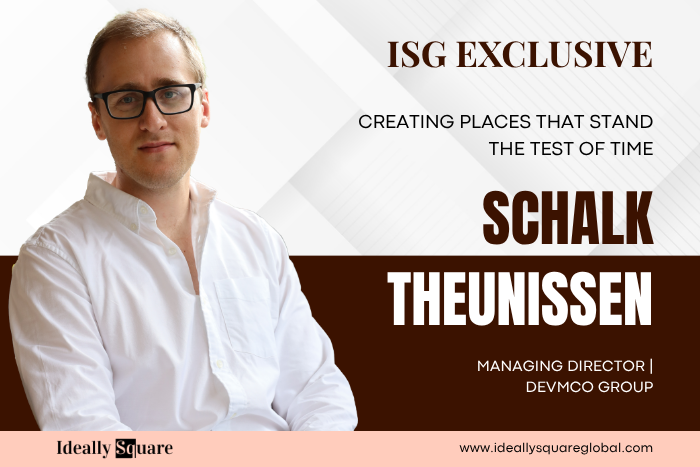
Schalk Theunissen, Managing Director of DEVMCO Group, believes the most enduring developments are those that create value far beyond the buildings themselves. Drawing on his experience in quantity surveying, infrastructure, contract management, and property development, Schalk leads large-scale integrated developments designed around long-term growth, strong infrastructure, sustainability, and community wellbeing. His approach combines disciplined planning, responsible investment, innovation, environmental stewardship, and collaboration to create connected precincts that strengthen tourism, attract investment, generate employment, and contribute to the long-term prosperity of South Africa's KwaZulu-Natal North Coast.
Schalk Theunissen: Creating Places That Stand the Test of Time
Communities are rarely defined by the day their first building is completed. Their true identity emerges over time through the roads that connect them, the businesses they attract, the public spaces that encourage interaction, and the confidence they inspire in the people who choose to live, work, and invest there. Behind every thriving precinct lies years of deliberate planning, disciplined decision-making, and a willingness to think beyond individual developments. The most enduring projects are those that anticipate tomorrow's needs while creating lasting value for generations, transforming land into places that contribute to both economic growth and everyday life.
This long-term perspective defines Schalk Theunissen's approach to property development. As Managing Director of DEVMCO Group, he leads the delivery of large-scale, integrated developments that combine residential, commercial, retail, hospitality, and public infrastructure into connected precincts designed for sustainable growth.
The Foundations of Enduring Leadership
For Schalk, a career in the built environment has been defined by far more than delivering successful developments. Beginning in quantity surveying, he gained an appreciation for the discipline that underpins every successful project. While numbers formed the technical foundation of his work, they also introduced him to the broader realities of construction, understanding risk, managing contracts, balancing timelines, and recognizing how even the smallest decisions can influence the outcome of an entire development.
His professional journey through quantity surveying, procurement, contract administration, and property development steadily expanded his perspective. Along the way, he came to understand that successful developments are never solely about constructing buildings; they are about making sound judgments, challenging assumptions when necessary, trusting capable teams, and maintaining a long-term view of every decision.
These experiences continue to shape his leadership philosophy today. Schalk believes effective leadership requires staying close enough to the detail to understand risks without becoming so involved that it limits the growth and accountability of others. Guided by transparency, responsibility, and long-term thinking, he approaches every project with the understanding that the decisions made today continue influencing communities for decades to come.
The Business of Building Communities
As Managing Director of DEVMCO Group, Schalk's vision extends well beyond delivering successful developments. He believes exceptional projects should continue creating value decades after completion, shaping communities that remain relevant, functional, and attractive long into the future.
This philosophy influences every aspect of DEVMCO's development strategy. Rather than focusing on isolated projects designed to meet immediate market demand, the company prioritizes creating integrated precincts supported by quality infrastructure, commercial opportunities, green spaces, security, and vibrant community environments.
His experience along KwaZulu-Natal's North Coast has reinforced the transformative role responsible private-sector development can play. Well-planned precincts stimulate employment, strengthen tourism, attract investment, and foster confidence in surrounding communities. Developments such as Sibaya Coastal City demonstrate how thoughtful planning can generate benefits that extend far beyond property value alone.
For Schalk, South Africa's future depends on practical, investable, and sustainable growth. DEVMCO contributes by combining private investment, disciplined planning, and effective implementation while remaining committed to delivering meaningful progress despite the challenges that inevitably accompany large-scale development.
Creating Developments with Lasting Purpose
Every major development begins with a simple but essential question for Schalk: Does it have a genuine reason to exist?
Rather than responding solely to current market enthusiasm, he evaluates projects based on their ability to satisfy long-term demand, integrate with existing infrastructure, improve surrounding communities, and remain financially sustainable. These considerations form the foundation of responsible development.
He also recognizes that successful mixed-use developments are shaped long before construction begins. Years of planning, engineering, environmental assessments, regulatory approvals, infrastructure coordination, and stakeholder engagement determine whether a project ultimately succeeds or falls short of its potential.
Within DEVMCO, careful planning, strong governance, and disciplined execution remain central priorities. Equally important is ensuring every stakeholder, from engineers and architects to financiers, environmental specialists, contractors, planners, and public-sector partners, works toward a shared vision. According to Schalk, this alignment transforms highly complex developments into achievable long-term successes.
Recognition Rooted in Regional Impact
Recognition at the Durban Tourism Business Awards represented more than an achievement for DEVMCO. For Schalk, the award acknowledged the broader economic contribution that thoughtful development can make to an entire region.
He believes successful developments should strengthen tourism, encourage investment, generate employment, and improve the attractiveness of surrounding communities. Awards that recognize regional impact carry particular significance because they reflect outcomes extending well beyond individual buildings or commercial success.
Schalk also views such achievements as collective accomplishments. Behind every completed development stands a network of professionals, consultants, contractors, investors, municipal partners, sales teams, and numerous stakeholders whose shared commitment transforms ambitious visions into reality.
Most importantly, the recognition reinforced DEVMCO's broader mission along the KwaZulu-Natal North Coast: creating destinations rather than standalone developments. By integrating tourism, infrastructure, lifestyle, and investment into cohesive precincts, the company continues contributing to long-term regional prosperity.
Creating Value That Grows Over Time
Having worked extensively across both public-sector infrastructure and private-sector development, Schalk has developed a balanced understanding of sustainable growth. His experience has demonstrated that neither sector succeeds independently; meaningful progress occurs when public investment and private enterprise complement one another.
Public infrastructure establishes the foundation for long-term community benefit, while private development introduces commercial discipline, investment, and implementation capacity. Together, they unlock opportunities capable of transforming entire regions.
Infrastructure such as transport networks, water systems, and bulk services often creates value far beyond individual developments by encouraging further investment and improving accessibility. At the same time, Schalk believes private developers have a responsibility to consider how their projects contribute to the broader environment rather than focusing exclusively on their own sites.
For him, sustainable growth is measured by the value that continues expanding over time. A successful development is not defined by its first sales cycle or initial occupancy levels, but by its ability to generate employment, improve connectivity, strengthen surrounding communities, and maintain investor confidence long after construction has been completed.
Infrastructure as the Catalyst for Growth
Schalk believes infrastructure represents one of South Africa's greatest opportunities for long-term economic development. Reliable electricity, water security, transport networks, municipal capacity, and efficient approval processes all influence investor confidence and determine whether regions are able to unlock sustainable growth.
Rather than simply identifying these challenges, he advocates for greater collaboration between the private and public sectors to develop practical solutions. Meaningful progress, in his view, comes from constructive engagement among developers, engineers, municipalities, provincial authorities, and funding partners rather than isolated efforts.
His experience on the KwaZulu-Natal North Coast has demonstrated how strategic infrastructure investments can reshape entire regions. Projects such as the M27 upgrade and the infrastructure surrounding Salt Rock City illustrate how roads, services, and accessibility extend benefits well beyond individual developments. By looking beyond project boundaries, Schalk believes developers can play a significant role in creating environments that continue attracting investment and supporting regional prosperity.
Building Cities with a Long-Term Vision
For Schalk, Sibaya Coastal City represents far more than a collection of individual developments. It reflects a carefully planned vision of an integrated urban environment where residential, commercial, retail, hospitality, healthcare, recreational facilities, and natural spaces work together as one connected precinct.
Creating this kind of development demands patience and disciplined planning. Rather than attempting to deliver every component simultaneously, Schalk believes successful precincts evolve in carefully considered phases, allowing infrastructure, market demand, and surrounding communities to develop together. Maintaining this long-term perspective often requires resisting short-term opportunities that may compromise the broader vision.
The success of Sibaya also reinforces a broader shift in buyer expectations. Modern communities increasingly seek complete lifestyle destinations that combine convenience, security, accessibility, employment opportunities, quality public spaces, and strong environmental integration. According to Schalk, developments that successfully combine these elements create lasting value for residents, businesses, and investors alike.
Where Planning Protects Progress
Schalk's background in quantity surveying and contract management has shaped a disciplined approach to managing risk across complex developments. Years of working with procurement, contract administration, NEC, JBCC frameworks, and project governance have taught him that effective risk management begins well before construction starts.
For him, the earliest decisions often have the greatest impact. The way projects are structured, professional teams are appointed, procurement strategies are developed, and project constraints are identified, all of which influence future outcomes. Addressing potential challenges honestly from the outset creates stronger foundations for successful delivery.
He also views contracts as far more than legal documentation. They establish accountability, clarify responsibilities, and provide a structured framework for managing complexity throughout every phase of development. Combined with clear communication, strong governance, and proactive decision-making, these principles enable DEVMCO to resolve challenges before they affect project momentum.
Innovation That Delivers Practical Value
Technology continues transforming the property development industry, but Schalk believes innovation should always be measured by the value it creates rather than its novelty.
At DEVMCO, digital project management systems, GIS mapping, planning technologies, reporting platforms, and data-driven processes have become valuable tools for improving project visibility and supporting more informed decision-making. On large-scale developments, early access to accurate information enables teams to identify issues quickly, reduce delays, and improve overall project efficiency.
His understanding of smart development extends well beyond construction technology. Modern precincts increasingly require integrated digital infrastructure, enhanced security, energy efficiency, intelligent mobility solutions, and sustainable design principles that improve everyday living.
Rather than introducing technology for its own sake, Schalk believes successful innovation should quietly improve how places function while creating environments that remain practical, resilient, and adaptable for years to come.
The Balance That Builds Better Communities
Schalk rejects the idea that commercial performance and social responsibility compete with one another. Instead, he believes the strongest developments demonstrate how both priorities reinforce lasting value.
Projects that overlook environmental stewardship, community wellbeing, or long-term management ultimately weaken their own commercial potential. Growing public awareness and higher market expectations mean responsible planning has become an essential component of sustainable investment rather than an optional consideration.
This philosophy influences DEVMCO's planning process from the earliest stages. Environmental management, conservation, landscaping, public spaces, security, accessibility, and long-term precinct maintenance are incorporated into project planning rather than introduced as secondary initiatives. Along the KwaZulu-Natal North Coast, where natural landscapes remain central to the region's identity, protecting these assets is fundamental to preserving the qualities that attract residents, businesses, and investors.
While financial discipline remains essential for delivering successful developments, Schalk believes the greatest projects achieve something more enduring. By aligning commercial viability with environmental responsibility and community benefit, developments create stronger places, lasting confidence, and sustainable value that continues growing well beyond completion.
Keeping Progress in Motion
Throughout his career, Schalk has learned that the most demanding developments are rarely defined by a single challenge. Instead, they involve numerous interconnected elements that must progress in careful coordination. Regulatory approvals, infrastructure planning, funding, design, environmental compliance, stakeholder engagement, and public-sector processes all influence a project's trajectory, and delays in one area can affect every other aspect of delivery.
He points to Salt Rock City as a clear example of this reality. As a significant private investment with long-term development potential, the project has required careful navigation of complex road planning, municipal processes, and stakeholder alignment. While much of this work takes place behind the scenes, Schalk believes it is precisely where leadership is most thoroughly tested.
These experiences have reinforced several important lessons. Successful leadership requires patience, factual decision-making, strategic persistence, and a team that remains focused on the broader objective. Above all, Schalk believes maintaining momentum is essential, as once confidence in a project begins to fade, rebuilding it becomes considerably more difficult.
Building the Communities of Tomorrow
For the future, according to Schalk, the concept of integrated precincts is likely to play a bigger role within the property development industry in South Africa. What purchasers now desire from properties is not merely one residential, commercial, or retail property, but an entire environment that combines such attributes as safety, convenience, education, employment opportunities, health services, recreation facilities, and nature.
Furthermore, Schalk expects that the ability of infrastructure to withstand external challenges will become even more of a decisive factor. Consistent supply of energy, water supply, transportation, and IT connections will play an increasingly larger role in investors’ and consumers’ choice as they look for reliability and stability.
Finally, lifestyle will become more of a criterion in economic decisions. In the region of KwaZulu-Natal North Coast, Schalk has noticed how quality of life, green areas, safety, and availability of various amenities can impact the place of people’s residence and investments.
Creating a Culture That Sustains Excellence
According to Schalk, organizational culture does not consist of things that are said, but what actually happens in organizations on a day-to-day basis. It is evident in the way that meetings are held, decisions are taken, problems are resolved, and people are entrusted with tasks.
The key principles of Schalk's leadership include giving opportunities to competent people and at the same time making sure of their accountability. Offering autonomy gives people an opportunity to learn how to become leaders themselves, however, it is important to make sure that there are set boundaries and expectations.
Innovation may come up from those people who are close to the process. Regardless of whether it is a quantity surveyor, engineer, project manager, or member of the site team, any ideas may prove to be valuable. That is why Schalk values an environment where constructive criticism of the existing processes is welcomed, as long as it promotes better performance.
It is important to understand that excellence is achieved through consistent execution and not isolated results. With accountability, collaboration, and improvements DEVMCO continues creating a culture of success.
Building a Legacy That Endures
Looking ahead, Schalk hopes DEVMCO will be recognized as an organization that delivered meaningful developments with integrity while contributing positively to South Africa's growth. His ambition is for the company's projects to be remembered not simply as successful property developments, but as destinations that created employment, attracted investment, strengthened infrastructure, and inspired long-term confidence throughout the KwaZulu-Natal North Coast.
While the concept of legacy is often discussed in broad terms, Schalk approaches it from a practical perspective. For him, lasting impact is measured by whether opportunities were created for employees, partnerships were built on trust, investors remained confident because commitments were fulfilled, and surrounding communities continued benefiting long after projects were completed.
His perspective is also shaped by his role as a father. It has strengthened his belief that development should never be viewed solely through the lens of immediate commercial performance. Instead, it should focus on creating places that future generations will inherit with pride. If DEVMCO can contribute meaningfully to building stronger communities, improving infrastructure, and shaping a more prosperous future, Schalk believes that will represent a legacy truly worth leaving behind.
A Shared Vision for South Africa's Growth
Despite all the difficulties, Schalk is optimistic concerning the potential of South Africa in the long run. His reasoning is based on the fact that the country has a young demographic composition, an entrepreneurial spirit, prime locations, and huge needs in terms of infrastructure. Therefore, he sees opportunities that are capable of contributing to the growth of economy if the process is controlled and carried out efficiently.
In the future, Schalk sees the development of property in such a way that it will be associated not with single properties but with integrated projects. The latter should include proper infrastructure, commitment to the environment, and commercial considerations. Moreover, rather than merely providing more property, the development of the future should focus on addressing the actual needs of communities and building places that would make people’s lives better.
Collaboration is the way to go, according to Schalk. It seems that neither government nor business can unlock the potential of South Africa alone. Instead, it is necessary to establish a partnership between both parties to build better infrastructure and help communities to grow and develop. With this approach, DEVMCO can have a say in shaping the future of communities.
Read the full issue
Open Magazine →