Middle East's Most Influential Construction & Project Management Leaders to Watch in 2026
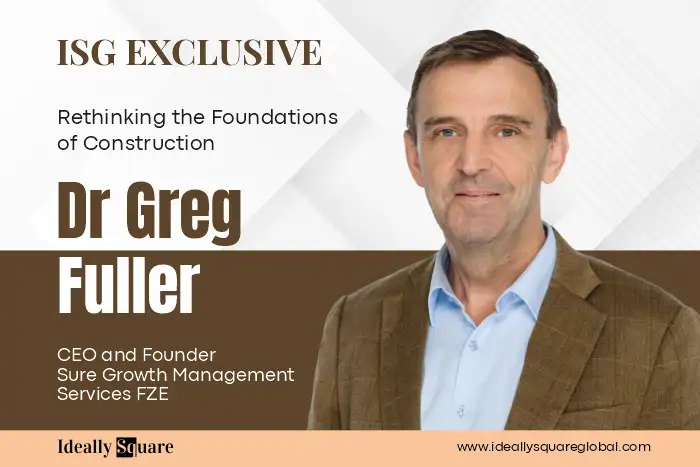
As Founder and CEO of Sure Growth Management Services FZE, Dr Greg Fuller has spent decades challenging conventional thinking in construction, advocating for sustainable practices, developing innovative management systems, and helping organisations make better decisions through data, technology, and long-term planning.
Introduction
A construction site is often described as organised chaos. Hundreds of people, thousands of moving parts, relentless deadlines, tight budgets, changing conditions, and constant problem-solving. Introducing sustainability into that environment can seem like adding another layer of complexity. Yet for a growing number of industry leaders, sustainability is no longer an optional consideration; it is becoming a measure of whether a project is truly successful.
That belief has shaped much of Greg Fuller's professional life. As Founder and CEO of Sure Growth Management Services FZE, Greg has spent decades challenging conventional thinking in construction, advocating for sustainable practices, developing innovative management systems, and helping organisations make better decisions through data, technology, and long-term planning.
Built by Blueprints and Ambition
Greg's journey into construction management began long before he entered the professional world. Growing up around building sites, he developed an early fascination with how structures came together. While he initially preferred pursuing an apprenticeship, his parents encouraged him to attend university, leading him to complete a Bachelor of Building at the University of New South Wales. The degree exposed him to an extraordinary breadth of disciplines, including design, structural engineering, property management, accounting, law, town planning, and even bricklaying.
Determined to manage major projects, Greg secured the sole cadetship available at Graeme Evans Construction, then part of the largest civil construction company in the Southern Hemisphere. Starting as a purchasing officer, he quickly progressed to managing projects, with a multi-storey car park becoming one of his earliest significant assignments.
His attention to detail and ability to identify inaccuracies in documentation became defining professional strengths. These skills helped him achieve major milestones, including playing a pivotal role in the Sydney International Airport Terminal expansion in 1990. During this period, he established what he describes as the world's first actively functioning construction quality assurance system and safety management system.
Over the years, Greg expanded his expertise across project management, commercial management, and sustainable design. From launching his own company in Canberra and designing solar passive homes to refining commercial management practices in the United Kingdom and eventually founding Sure Growth Management Services in Dubai, his career has remained focused on innovation, sustainability, and improving industry standards.
Leadership Through Understanding
More than four decades of experience have shaped Greg's leadership philosophy around a simple belief: every individual thinks, learns, and communicates differently. He believes effective leadership begins with understanding those differences and adapting communication styles accordingly.
This perspective was influenced by personal experiences. Growing up alongside an uncle who was deaf and legally blind taught him the importance of tailoring communication to ensure mutual understanding. Later, a lesson from his teenage son reinforced another core belief, that valuable ideas can come from anyone, regardless of age, experience, or formal training. When his son proposed a solution to a major construction challenge that ultimately worked, Greg's appreciation for diverse perspectives deepened significantly.
Working across countries such as Singapore, Spain, and the United Kingdom further highlighted the importance of effective communication. To strengthen this skill, Greg completed training in teaching English as a second language, helping him better navigate cultural and linguistic barriers in international environments.
At the heart of his leadership approach is a communication framework built around the "Five Ws", What, Where, When, How, and Why. He believes that understanding others, communicating appropriately, and respecting every individual's contribution are the foundations upon which successful leadership is built.
Watching Sustainability Grow Up
Greg's commitment to sustainability dates back to the early 1990s, when sustainable construction was often viewed as unconventional. His early projects embraced recycled materials, mud brick construction, locally sourced timber, water recycling systems, and passive solar design principles long before such practices became mainstream.
Many of his designs challenged conventional energy assessment methods of the time. Greg often found that regulatory frameworks focused on simplistic measurements, such as glazing percentages and airtightness, without fully accounting for the benefits of solar orientation, natural ventilation, and passive heating and cooling strategies. As a result, many projects required individual planning approvals despite their strong sustainability credentials.
Over the decades, he has witnessed a significant evolution in the industry's understanding of sustainability. The conversation has expanded beyond environmental concerns to include social sustainability, creating a more balanced and holistic approach. Greg views regulatory improvements and the standardization of sustainability measurements as some of the industry's most important advances.
For him, education remains the driving force behind meaningful change. Increased public awareness of environmental challenges has encouraged greater acceptance of sustainable practices, helping move sustainability from a niche concept into a central industry priority.
A Vision for a Net-Zero UAE
As a LEED Accredited Professional and doctoral researcher specializing in construction management and sustainability, Greg sees enormous opportunities within the UAE's ambitious net-zero agenda. He views the country's commitment to achieving net-zero emissions by 2050 as one of the most exciting sustainability initiatives in the global construction sector.
At the same time, he acknowledges the challenges of building credibility as a relatively small company operating in a highly competitive market. To strengthen his influence and contribute more effectively to the UAE's sustainability objectives, Greg pursued a Doctor of Business Administration focused specifically on sustainability within the UAE construction industry.
After decades of exploring ways to create meaningful change, he ultimately concluded that establishing his own company offered the greatest opportunity to drive innovation and sustainability initiatives. Through strategic networking, professional development, and years of industry experience, Greg believes he is steadily positioning himself to contribute more significantly to the country's sustainability transformation.
When Technology Becomes a Competitive Advantage
Greg has long viewed technology as a powerful tool for improving efficiency and standardizing processes while maintaining flexibility for the unique demands of construction projects. His proprietary systems are designed to minimize duplicate data entry, streamline workflows, and use existing information to generate future project insights.
Although he recognizes the challenges of applying artificial intelligence in an industry where no two projects are truly identical, Greg has spent years developing automated systems capable of managing highly complex structures. More recently, he has focused on integrating AI to accelerate data collection and improve the speed and accuracy of project analysis.
He believes these technologies have the potential to transform project and cost management by enabling faster forecasting, greater precision, and improved adaptability to project changes. Beyond financial performance, Greg is also integrating real-time emissions tracking into his systems, allowing stakeholders to monitor environmental performance throughout construction rather than relying solely on post-project sustainability claims.
For Greg, technology is not merely an operational tool; it is becoming an essential requirement for remaining competitive in a rapidly evolving industry.
The Power of Data in Sustainable Construction
Greg believes that high-quality, real-time data is fundamental to effective decision-making in construction. Accurate reporting allows project teams to identify risks, challenges, and opportunities early enough to take corrective action before issues escalate into costly setbacks.
Data also plays a critical role in waste reduction. By measuring waste generation and disposal patterns throughout a project, construction teams can adjust methodologies, improve site management practices, and reduce the amount of material sent to landfill. Greg argues that meaningful change is only possible when organizations can clearly see the impact of their decisions through reliable data.
His broader research focuses on demonstrating how data can support long-term sustainability goals by revealing the consequences of different choices and guiding more informed decision-making. In his view, sustainability is rarely a straightforward journey. Like navigating a complex road, success requires constant adjustments, careful planning, and timely course corrections. Data provides the visibility needed to make those decisions with confidence.
Rethinking Sustainability Through Research
Through his ongoing research into the relationship between sustainability, cost, and programme performance in construction, Greg has identified several important insights. One of the most significant findings is that sustainable construction currently carries an immediate cost impact in the UAE, largely due to the way developments are traditionally structured. He believes the industry must move beyond focusing solely on the defects liability period and instead adopt a longer-term perspective that considers the full lifecycle value of buildings.
Greg argues that sustainability extends far beyond energy efficiency and emerging technologies. Effective management practices play an equally important role, while social and economic sustainability must be considered alongside environmental concerns. In his view, true sustainability can only succeed when it is economically viable and capable of delivering lasting value.
His research also highlights the importance of balance. Every decision involves trade-offs, and sustainable outcomes are achieved through carefully managing those compromises. Rather than promoting a single solution, Greg's work focuses on identifying alternative approaches that can help mitigate cost and programme impacts while supporting broader sustainability objectives. He believes these findings can contribute meaningfully to the UAE's ambitious journey toward net-zero construction.
Making Sustainability a Business Advantage
Greg believes construction companies can successfully balance commercial objectives with environmental responsibility by first improving their management practices. He advocates for a detailed examination of existing construction methods to identify opportunities for reducing waste, improving efficiency, and selecting materials with lower embodied energy.
However, he emphasizes that meaningful industry-wide change requires strong legislative and regulatory support. According to Greg, developers are often reluctant to invest additional capital during construction when the financial benefits are realized primarily over the building's operational life. Regulations can help align industry priorities by ensuring all stakeholders operate under the same expectations and standards.
He also sees opportunities for developers and contractors to differentiate themselves through innovation. New technologies, sustainable design strategies, and forward-thinking construction methods can enhance market credibility and position companies as industry leaders. Nevertheless, Greg believes the greatest influence lies with developers, whose decisions shape material selection, design direction, and long-term sustainability outcomes. Contractors, meanwhile, require greater education and awareness to understand how sustainable practices can be implemented without significantly increasing project costs.
The Next Wave of Construction Innovation
Looking toward the future, Greg expects prefabrication and the expanded use of recycled materials to become major drivers of sustainable construction. Manufacturing building components under controlled conditions can improve quality, reduce waste, and create more efficient installation processes on-site.
He also anticipates growing adoption of advanced monitoring and reporting systems capable of providing real-time visibility into project performance. Such technologies will enable more informed decision-making and support improved sustainability outcomes throughout a project's lifecycle.
Beyond technological innovation, Greg sees social sustainability becoming increasingly important in both development planning and urban design. He points to the UAE's growing emphasis on community-focused development as evidence of this shift. While renewable energy and energy efficiency will remain central priorities, he believes the next decade will place greater focus on end-to-end material management, circular economy principles, and practical systems for recycling and reuse.
Leading Beyond Conventional Thinking
For the next generation of construction professionals, Greg's advice is simple but powerful: think independently. He encourages future leaders not to accept conventional wisdom unquestioningly, whether it comes from universities, governments, or large corporations.
Throughout his career, Greg has learned that there is rarely only one path to solving a challenge. He believes innovation emerges when individuals are willing to explore alternatives, question assumptions, and search for better solutions. Rather than viewing obstacles as problems, he prefers to see them as challenges or opportunities that invite creative thinking.
Using a simple analogy, Greg compares a challenge to the inside of a box and the potential solutions to the sides surrounding it. Most people focus on a single answer, but he argues that multiple solutions often exist. By exploring different perspectives and approaches, future professionals can drive meaningful advances in sustainability, project management, and industry innovation.
For Greg, the future belongs to those willing to think beyond the obvious, challenge established norms, and continuously seek better ways to create positive change.
A Life Beyond Construction
Greg's success, however, is not limited to the field of construction management and sustainability. He was born in Sydney, Australia, and has managed to develop a career that is characterised by creativity, leadership, social work, and a desire to always progress.
One of the most significant accomplishments Greg is proud of is the creation of what he calls the world's first ever working construction site safety management and quality assurance program. The creation of the structure itself is just one part of his achievement; Greg created the policies, procedures, checklists and systems that helped make it work, thereby setting new standards for construction project management.
His experience and interest in life are not limited to the construction industry only. Greg has taken part in the opening and closing ceremonies of the Sydney 2000 Olympics and has even worked as a dance host on cruise ships, which reflects his other side as opposed to his technically oriented job.
A graduate of the University of New South Wales Bachelor of Building program, Greg says that education helped him develop an interest in sustainability, and since then he has never stopped developing professionally by taking different courses and certification programs.
Helping others has been a significant aspect of his life all along. Eight years have gone by as a volunteer ambulance officer in Tasmania as well as eight years as a volunteer firefighter. He has also been involved in rescue diving and educational programs through volunteering as a teacher in schools.
Greg is an enthusiastic traveler who has traveled to 167 different countries and even gone on some very tough expeditions across the world, which includes Mount Everest Base Camp and Mount Kilimanjaro trips. His devotion to charities is as impressive as it is because he has participated in three full marathon runs and four half marathons for cancer research in the UK.
From a professional perspective, Greg has worked in Australia, Singapore, Spain, the United Kingdom, and the UAE. His consultancy projects have taken him to Africa, New Zealand, India, Portugal, and the United States. As his company keeps growing, he is planning to set up operations in India and is working with sustainability experts to promote green construction in the region.
His entrepreneurial drive has also led to the development of proprietary construction cost management systems for which patent applications have been submitted. In parallel, he created an advanced project management application capable of providing live project monitoring, integrating programme management, inspections, approvals, compliance reporting, and emissions tracking into a single platform.
Sustainability has remained a constant focus since the mid-1990s, when Greg began designing eco-friendly, solar-passive homes in regional Australia. Over the decades, he has championed sustainable construction practices across every organisation he has worked with, consistently advocating for greener design solutions and long-term environmental responsibility. Among his most ambitious projects was the design of a fully accessible, solar-passive, carbon-neutral resort development in New South Wales in 2002.
Driven by a desire to create greater impact, Greg ultimately founded his own consultancy to accelerate the adoption of sustainable construction practices. Through continued research, professional accreditation, and innovation, he remains committed to helping shape a more sustainable future for the global built environment.
Read the full issue
Open Magazine →