Argentina's Top Women AI & Technology Visionaries to Watch in 2026
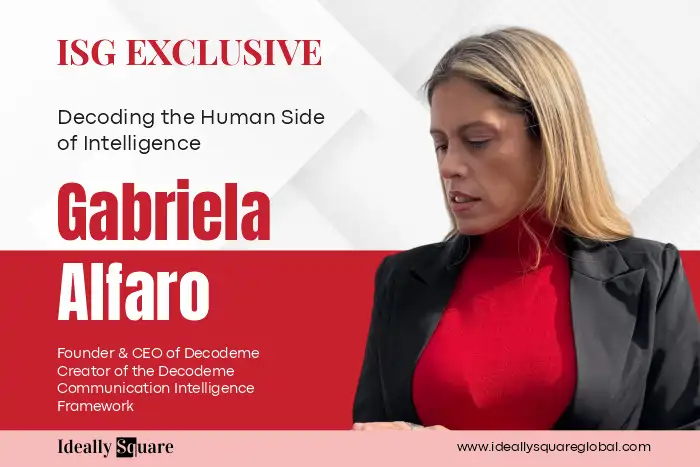
Long before challenges become visible in results, they often appear in conversations, where a missed nuance, unspoken concern, or misunderstood message can influence decisions, collaboration, and culture. Gabriela Alfaro's work explores the human layer behind organizational performance, focusing on the intentions, perceptions, emotions, behaviors, and relationships that shape how people work together. As an AI researcher, technology leader, and Founder & CEO of Decodeme, she combines artificial intelligence with communication, behavioral science, and neurodiversity. Her work led to the creation of Decodeme, a communication intelligence platform designed to uncover deeper patterns within workplace interactions. Through the Decodeme Communication Intelligence Framework, she explores tone, implicit intentions, emotional signals, behavioral patterns, power dynamics, and psychosocial risks.
Vision for Communication Intelligence
Gabriela is an AI researcher, technology leader, and Founder & CEO of Decodeme, whose work sits at the convergence of artificial intelligence, communication, behavioral science, and neurodiversity. With more than two decades of experience in software development, enterprise architecture, cloud technologies, and artificial intelligence, and having completed the MIT program in Artificial Intelligence in Healthcare, her primary focus today is the development of Decodeme, a communication intelligence platform designed to uncover the deeper patterns that exist beneath workplace conversations.
Rather than focusing solely on the literal content of communication, Decodeme examines tone, implicit intentions, emotional signals, power dynamics, behavioral patterns, and psychosocial risks present in written and transcribed interactions. At the heart of the platform is Gabriela's Decodeme Communication Intelligence Framework, an interdisciplinary model that combines behavioral sciences, neuroscience, communication theory, social psychology, systems thinking, complexity science, artificial intelligence, and neurodiversity. Through this work, she aims to make hidden communication patterns more visible, helping individuals and organizations respond with greater awareness and responsibility.
Alongside Decodeme, Gabriela contributes as a technology researcher to an initiative at the National University of Río Negro, supporting the development of accessible questionnaires and audiovisual materials for caregivers of autistic children experiencing sleep difficulties. She also continues exploring ideas related to learning, cognitive development, responsible AI, and the future of organizations.
Discovering a Critical Gap
Gabriela's interest in the relationship between artificial intelligence and human communication emerged through a blend of technical expertise and real-world observation.
Having spent years working with software architecture, enterprise systems, cloud technologies, and AI, she developed a deep understanding of how complex systems operate and how patterns can be identified within vast amounts of information. However, she also noticed that many organizational challenges were not caused by a lack of information but by the way information was interpreted, transmitted, ignored, or distorted.
She observed that messages could be technically correct while still creating confusion, meetings could appear productive while key disagreements remained unspoken, and teams could believe they were aligned while operating from entirely different interpretations. These observations inspired the creation of Decodeme, driven by a central question: could technology help people recognize these communication patterns earlier without compromising privacy or replacing human judgment?
Understanding Communication as a Human System
The Decodeme Communication Intelligence Framework views communication as far more than an exchange of words. Gabriela developed it as a conceptual and technological model that examines the complex relationship between language, context, emotion, intention, behavior, cognition, culture, power, and organizational structures.
The framework integrates multiple disciplines, including behavioral sciences, neuroscience, communication studies, social psychology, systems thinking, complexity theory, artificial intelligence, and neurodiversity. By combining insights from these fields, it seeks to create actionable understanding without oversimplifying the complexity of human interaction.
Its guiding question extends beyond "What was said?" to include deeper considerations such as how communication is interpreted, what underlying dynamics may be present, and how individuals and organizations can respond more consciously.
Revealing the Hidden Signals in Workplace Communication
Through Decodeme, Gabriela has developed tools capable of analyzing written messages and transcribed conversations to identify communication patterns that are often difficult to detect manually.
The platform can examine indicators such as tone, irony, emotional variation, empathy, interruptions, dominance, behavioral drift, implicit intentions, divergence between intended and perceived meaning, and psychosocial risk. It offers insights at both the individual and organizational levels.
For individuals, Decodeme can support emotional regulation, meeting preparation, reflective thinking, communication development, and cognitive training. For organizations, it can reveal anonymized patterns across teams, helping identify communication friction, shifts in team dynamics, or areas requiring attention.
Importantly, Gabriela emphasizes that the platform is not intended to function as a surveillance tool. Its architecture prioritizes anonymization, privacy, and responsible use, ensuring that communication analysis supports healthier collaboration rather than punishment or excessive monitoring.
Why Communication Intelligence Matters More Than Ever
Gabriela believes that modern organizations operate in an environment defined by increasing complexity, rapid change, distributed workforces, cultural diversity, and cognitive overload. Within this context, communication challenges can have significant operational and human consequences.
Misunderstandings can delay decision-making, weaken collaboration, damage customer relationships, and contribute to workplace stress. In many cases, leaders only recognize these issues after measurable damage has already occurred.
Communication intelligence offers a way to move beyond assumptions and impressions by providing greater visibility into how communication is functioning across teams and organizations. For Gabriela, the value lies not in quantifying every human interaction but in helping organizations ask better questions and make more informed decisions while preserving the human dimension of work.
Building Responsible AI Through Privacy and Transparency
For Gabriela, privacy is not simply a feature of communication intelligence systems; it is a prerequisite for their legitimacy.
She advocates for approaches that prioritize consent, transparency, data minimization, anonymization, access control, and clear limitations on how information is used. Individuals should understand what is being analyzed, why it is being analyzed, who can access the results, and what decisions can or cannot be made based on that information.
Her philosophy of responsible AI extends beyond compliance requirements. She believes that privacy, explainability, human oversight, and ethical safeguards must be incorporated into the design process from the very beginning. Decodeme reflects this philosophy by focusing on anonymized patterns while preserving contextual understanding and ensuring that technology remains a support for human judgment rather than a replacement for it. As she puts it, no algorithm should become the final authority on a person's emotions, intentions, competence, or value.
Neurodiversity as a Foundation for Better Understanding
Neurodiversity plays a central role in Gabriela's thinking about communication and organizational inclusion.
She recognizes that individuals process language, social cues, ambiguity, sensory information, and emotional signals in different ways. When organizations assume a single "correct" communication style, they risk misinterpreting differences as incompetence, disengagement, or hostility.
Gabriela advocates for a more nuanced understanding of communication—one that acknowledges its relational and contextual nature. Her work encourages organizations to recognize that the same message may be experienced differently by different people and that these differences should be understood rather than judged.
Drawing from both personal and professional experiences, she views technology as a tool that can expand understanding and accessibility when designed to accommodate diverse ways of thinking and communicating.
Lessons Learned from Building Decodeme
One of Gabriela's most significant discoveries has been that technical capability alone is not enough to create meaningful impact.
A system may successfully identify patterns, but organizations still need the right context to interpret and act on those insights responsibly. This requires clearly defined objectives, ethical boundaries, meaningful indicators, and a shared understanding of how the technology will be used.
She has also learned that communication is not something added after a product is built; it is embedded within the product itself. The way systems explain signals, communicate uncertainty, and present recommendations directly influences how people interpret and respond to information.
These experiences have reinforced her belief that artificial intelligence should help people become more aware of their decisions rather than less accountable for them.
Human Judgment in an AI-Driven Future
Gabriela views artificial intelligence and human judgment as complementary rather than interchangeable capabilities.
AI excels at processing large volumes of information, identifying recurring patterns, and uncovering relationships that might otherwise go unnoticed. Human beings, however, contribute context, ethical reasoning, lived experience, accountability, and the ability to determine what truly matters in a given situation.
In her vision, the most effective systems create a productive dialogue between these strengths. AI can provide signals and insights, but people must decide how those insights should be interpreted and applied. She believes the future of technology should empower stronger human judgment rather than encourage unquestioning reliance on automated systems.
Learning, Knowledge, and Organizational Memory
Beyond communication intelligence, Gabriela's work extends into broader questions about learning, decision-making, collaboration, and knowledge preservation.
She is actively exploring how educational assessment must evolve in a world shaped by generative AI. In her view, future evaluation methods should place greater emphasis on authentic understanding, reflection, learning processes, and the practical application of knowledge rather than outputs that can easily be generated by machines.
She is also interested in the concept of organizational memory. As modern organizations generate enormous volumes of documents, meetings, messages, audio, and video content, valuable knowledge often becomes difficult to locate and reuse. Gabriela believes technology can help structure and preserve this information while maintaining traceability to its original sources.
Across all of her initiatives, a common principle remains constant: information becomes truly valuable when it enables people to understand more clearly, learn more effectively, make better decisions, and act with greater awareness.
Innovation Begins with a Different Way of Seeing
For Gabriela, innovation is far more than the creation of something new. She views it as the ability to perceive a problem differently and transform that new understanding into a practical solution.
While innovation can certainly emerge through technological breakthroughs, she believes it can also take the form of improved processes, more inclusive approaches, or simply asking better questions at the right time. In her view, meaningful innovation requires a balance between imagination and discipline. Ideas must have a clear purpose, be tested against reality, and remain open to evidence that may challenge initial assumptions.
Most importantly, innovation should remain connected to human outcomes. Gabriela believes the most transformative innovations are often those that reveal previously hidden patterns, enabling people to see situations differently and make better choices as a result.
The Real AI Challenge Is Organizational Readiness
As artificial intelligence becomes increasingly embedded in business operations, Gabriela believes the greatest challenge is not technological adoption itself but ensuring that organizations develop the cultural, ethical, and cognitive readiness required to use AI responsibly.
She observes that many organizations focus heavily on automation, efficiency, and new tools, often overlooking the broader implications AI has on responsibility, decision-making, communication, learning, and power structures. Without thoughtful governance and adequate preparation, organizations risk creating new forms of dependency, reducing transparency, or unintentionally reinforcing existing biases.
For Gabriela, the central challenge is not simply learning how to use AI effectively. It is learning how to preserve critical thinking, accountability, and human judgment while integrating increasingly powerful technologies into everyday work.
Leading Through Uncertainty in the Age of AI
Recognizing that many leaders and professionals approach AI with uncertainty, Gabriela offers a perspective grounded in inquiry rather than urgency.
In her view, leaders do not need to understand every new tool immediately, but they do need to understand the questions the technology raises. She encourages organizations to start with the problem rather than the tool: to ask what they are trying to improve, who may be affected, what information is truly necessary, and what should remain under human control.
Gabriela also cautions against confusing speed with progress. A fast implementation that creates mistrust, weakens judgment, or exposes sensitive information is not, in her words, a successful implementation. Looking ahead, she believes the most valuable skill in an AI-enabled world will not be the ability to produce more content or automate more tasks, but the ability to distinguish what should be automated, what should be questioned, and what should remain deeply human.
Expanding Communication Intelligence for the Future
Looking ahead, Gabriela aims to further develop Decodeme as a practical and responsible communication intelligence solution for organizations. Her focus remains on enterprise pilots that deliver measurable outcomes while maintaining strong commitments to privacy, ethical design, and inclusive collaboration.
She is particularly interested in partnering with organizations seeking deeper insights into communication patterns, psychosocial risks, team dynamics, and cognitive well-being without reducing people to simplistic metrics or scores.
Beyond product development, Gabriela hopes to contribute to broader conversations surrounding artificial intelligence, communication, learning, neurodiversity, and the future of work. Through speaking engagements, institutional collaborations, and educational initiatives, she seeks to encourage a more informed and balanced dialogue about the role of technology in society.
Her long-term vision is to promote a more mature understanding of AI, one that combines technical ambition with ethical responsibility, social awareness, and respect for the complexity of human experience.
A Philosophy Grounded in Human Understanding
Asked to summarize her philosophy in a single sentence, Gabriela answers without hesitation:
"Technology should not make us less human; it should help us see more clearly what being human requires."
That conviction runs through every part of her work, from the architecture of Decodeme to her thinking on education, organizational memory, and leadership. For Gabriela, the purpose of innovation is not simply to advance technology, but to help people and organizations become more aware of their decisions, more discerning in their judgment, and more responsible in how they act on what they come to understand.
Quotes
"Technology should not make us less human; it should help us see more clearly what being human requires."
"No algorithm should become the final authority on a person's emotions, intentions, competence, or value."
"Do not confuse speed with progress. A fast implementation that creates mistrust, weakens judgment, or exposes sensitive information is not a successful implementation."
About Gabriela Alfaro
Gabriela Alfaro is an AI researcher, technology leader, and Founder & CEO of Decodeme, working at the intersection of artificial intelligence, communication, behavioral science, and neurodiversity. She is the creator of the Decodeme Communication Intelligence Framework and the founder of Decodeme, a platform designed to identify communication patterns, implicit meaning, organizational dynamics, and psychosocial risk while preserving privacy. She completed the MIT program in Artificial Intelligence in Healthcare and has more than two decades of experience in software development, enterprise architecture, cloud technologies, and artificial intelligence. Her work also includes research and educational initiatives related to accessibility, learning, cognitive development, and the responsible use of technology.
Read the full issue
Open Magazine →