Most Influential Leaders in Data-Driven Business Transformation 2026
Organizations are transformed not by a single breakthrough but by thousands of better decisions. Paweł Zieliński shares how integrating finance, data, operations, and AI enables businesses to make smarter, faster, and more sustainable decisions.
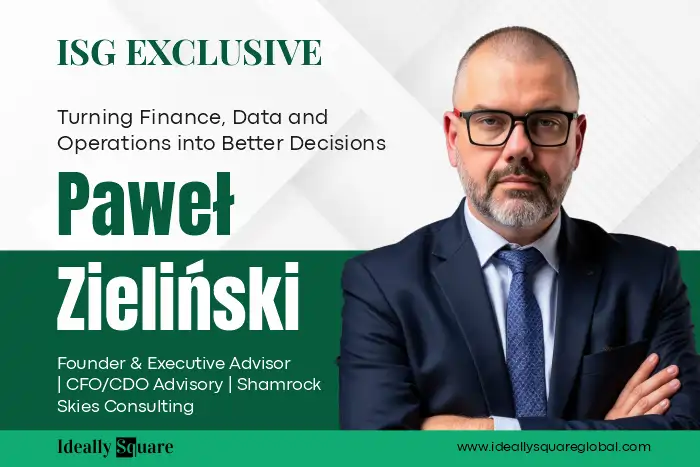
Paweł Zieliński: Turning Finance, Data and Operations into Better Decisions
Organizations are rarely transformed by a single breakthrough. They are shaped by thousands of decisions made every day, some visible, many unnoticed. A pricing adjustment, a production schedule, a procurement choice, a forecasting assumption, or a maintenance decision may appear independent, yet together they determine whether a business grows, stagnates, or struggles. Financial results merely record these choices after they have already taken effect. The real challenge has never been producing more reports or adopting more technology. It has been understanding the relationships between information, judgment, and action well enough to make the next decision better than the last. That pursuit has quietly become one of the defining disciplines of modern business leadership.
Paweł Zieliński has spent his career exploring that discipline from multiple perspectives. Having operated at the intersection of CFO and CDO responsibilities before establishing Shamrock Skies Consulting, he has consistently looked beyond financial outcomes to uncover the operational, technological, and organizational decisions that produce them
Following the Questions Behind the Numbers
Paweł never viewed his evolution from CFO leadership into data, analytics, and performance management as a shift from finance to technology. Instead, he describes it as a natural progression driven by a deeper question: why organizations make the decisions they do and how those decisions can be improved.
Early in his career as a CFO, he realized that financial figures represented only the outcome of much broader operational realities. Every variance reflected factors such as production performance, customer behavior, costing assumptions, process inefficiencies, or even inconsistent interpretations of the same business definitions. These observations gradually expanded his focus beyond finance to include data, systems, process ownership, and performance management.
This experience reshaped his understanding of leadership. While financial discipline remains fundamental, Paweł no longer views finance as the endpoint of reporting. Instead, he sees it as one element within a broader decision-making system. For him, the true value of data lies not in its technological sophistication but in its ability to help organizations understand reality more clearly, encourage accountability, and enable earlier, more informed decisions.
Lessons from the Factory Floor
Having worked with organizations including Amcor, SCA Packaging, and Dunapack Packaging, Paweł believes manufacturing offers one of the most honest measures of business performance. Regardless of how impressive presentations may appear, operational reality ultimately reveals itself through waste, downtime, quality performance, working capital, delivery reliability, and profitability. Sustainable business performance, he believes, always begins with respecting that operational truth.
Another important lesson has been the relationship between finance and operations. In his view, finance cannot simply report historical results after month-end, nor should operations perceive finance as merely a control function. The strongest organizations create a shared language where both teams understand the same operational drivers, including product mix, production yield, machine speed, setup times, raw material consumption, pricing, logistics, and capacity utilization.
Paweł also emphasizes the importance of balancing standardized processes with local accountability. While common frameworks are essential within multi-site manufacturing groups, they should never diminish ownership at the plant level. Effective performance systems establish consistent standards while empowering local teams to take responsibility for improving their own operational results.
The Truth Hidden in the Data
Contrary to popular belief, Paweł argues that manufacturing companies rarely struggle because they lack data. Most organizations possess more information than they can effectively utilize. The real challenge lies in fragmented systems, where valuable information is distributed across ERP platforms, production systems, planning tools, spreadsheets, and locally developed reporting practices. Although data is abundant, it is often not trusted.
He also points out that manufacturing data carries significant business context. Product codes, routing information, machine hours, waste percentages, and cost centers may appear technical, but each represents meaningful operational realities. When organizations fail to establish shared definitions, discussions become focused on reconciling reports rather than making better business decisions.
Another obstacle is ownership. Many organizations assume that IT departments or business intelligence teams are responsible for solving data challenges. While these functions provide essential technical expertise, Paweł believes they cannot define the business meaning behind data. Truly data-driven organizations require business leaders who take ownership of definitions, quality, governance, and the practical use of information within everyday decision-making.
The Real Purpose of Digital Transformation
Paweł believes organizations often fail to realize business value from technology because they begin by selecting tools rather than identifying the decisions they want to improve. Whether investing in dashboards, artificial intelligence, or new platforms, technology alone cannot define performance, assign ownership, improve processes, or determine the actions leaders should take.
Instead, he encourages organizations to begin by asking a more fundamental question: which business decisions require improvement? These may involve pricing strategies, product mix optimization, forecasting accuracy, waste reduction, or working capital management. Once the desired decision is clearly defined, it becomes much easier to determine the necessary data, assign ownership, establish quality standards, redesign processes, and measure expected business value.
From Paweł's perspective, the most successful data initiatives are never technology projects supported by business participation. They are business transformation initiatives where technology serves as an enabler rather than the primary objective.
Creating Trust Through Data Governance
Paweł believes data governance only appears theoretical until organizations encounter conflicting versions of the same business result during leadership meetings. In those moments, governance becomes an immediate business priority. Without common definitions, clear ownership, and reliable quality standards, analytical insights lose credibility, forcing organizations to spend valuable time reconciling information rather than improving performance.
He emphasizes that ownership of data belongs within business processes rather than solely within IT departments. Product structures, master data, customer hierarchies, costing parameters, and transactional discipline all require business ownership. While technology teams manage platforms and system integration, business leaders remain responsible for defining the meaning and practical application of data.
Paweł advocates building governance frameworks gradually, beginning with the business areas that create the greatest value. Organizations should identify critical data domains, assign clear owners and data stewards, establish common terminology through business glossaries, implement quality controls, and create escalation processes where necessary. Most importantly, governance should always be connected to measurable business outcomes, including improved profitability analysis, faster reporting, stronger forecasting capabilities, reduced disputes, and greater readiness for artificial intelligence.
The Purpose Behind Shamrock Skies
After spending many years leading finance, data, and performance initiatives within international manufacturing organizations, Paweł established Shamrock Skies Consulting with a clear purpose: helping businesses integrate finance, operations, and data into stronger decision-making systems. Rather than offering theoretical consulting frameworks, his advisory practice focuses on translating practical experience into meaningful business transformation.
His decision to launch the consultancy was driven by observing the same organizational challenges repeatedly across different companies. Fragmented reporting structures, unclear profitability, weak costing methodologies, excessive manual finance processes, disconnected systems, poor data ownership, and dashboards that informed without influencing behavior remained common issues. More recently, he has also seen growing enthusiasm for artificial intelligence without the necessary organizational readiness to support successful implementation.
Paweł believes organizations rarely need more theory. Instead, they need experienced advisors who can quickly understand business realities, communicate effectively across finance, operations, information technology, and executive leadership, and transform complexity into practical roadmaps. Through Shamrock Skies Consulting, he supports clients with interim CFO support, CDO advisory, finance transformation, controlling excellence, data governance, artificial intelligence readiness, and decision model design, always with the objective of helping organizations make better, faster, and more informed business decisions.
The Foundation Behind Successful AI
Paweł believes that genuine AI readiness begins long before organizations adopt artificial intelligence. In his view, it starts with identifying meaningful business problems and ensuring the organization is capable of acting on the insights AI provides. From a business perspective, he emphasizes that leaders must clearly understand where AI can generate measurable value, whether through forecasting, pricing, maintenance, planning, document processing, customer service, anomaly detection, or decision support. However, every use case should be directly connected to a specific business process and a clearly defined performance objective.
From a process perspective, Paweł stresses the importance of clearly defined responsibilities. If business processes lack structure, artificial intelligence simply accelerates existing inefficiencies. Organizations must establish who acts on AI recommendations, who validates them, who challenges them, and how outcomes are measured. Equally important is the data foundation. Reliable historical information, consistent definitions, strong quality standards, and responsible management of sensitive data are all essential. For Paweł, AI readiness is never solely about algorithms; it is fundamentally about trust, governance, adoption, and disciplined execution.
Looking Beyond the AI Hype
Paweł believes one of the most common misconceptions among executives is viewing artificial intelligence primarily as a technology initiative. While technology is certainly important, he argues that the real questions are business questions. Organizations should first determine which decisions they want to improve, what risks they are addressing, who will use the AI-generated insights, and how success will ultimately be measured.
He also challenges the assumption that artificial intelligence can compensate for poor-quality data. In reality, AI often exposes inconsistent definitions, weak processes, and unreliable information much more quickly than traditional reporting systems. Another frequent mistake, in his view, is launching numerous AI pilots without a clear implementation strategy. Instead, Paweł advocates a portfolio-based approach that evaluates business value, data readiness, adoption challenges, and scalability before expanding successful initiatives. The ultimate objective, he believes, is not simply to claim AI adoption but to achieve measurable improvements in performance, efficiency, quality, risk management, and customer value.
Transformation Begins with Strong Foundations
Throughout his career, Paweł has led numerous finance transformation, restructuring, and performance improvement initiatives. Among the most significant was a finance and control transformation within a multi-plant packaging organization following a challenging audit. While the immediate objective appeared to be improving reporting, the deeper priority was rebuilding organizational trust in internal controls, business processes, management information, and the finance function itself.
The transformation focused on practical improvements rather than ambitious technology initiatives. Responsibilities were clarified, internal controls strengthened, reporting discipline enhanced, and closer collaboration established between finance and plant management. Financial reporting was reconnected with operational reality, creating a more reliable foundation for future decision-making.
For Paweł, this experience reinforced an important leadership lesson: meaningful transformation often begins with mastering the fundamentals. Clear ownership, disciplined financial closing, transparent variance analysis, well-defined processes, and honest dialogue between finance and operations establish the trust necessary for more advanced digital transformation initiatives to succeed.
Bringing Finance, Operations, and Data Together
Paweł believes that finance, operations and data teams add the most value when they are organized around business decisions, rather than reporting structures. Each function contributes a unique perspective. Finance provides commercial discipline, forecasting and value creation. Operations provides practical process knowledge and operational constraints. Data teams provide architecture, integration and analytical capabilities. The real business value comes when these perspectives are brought together early in the decision-making process rather than after reports or dashboards have been developed.
He prefers organizational models where each key business domain such as profitability, production performance, working capital or forecasting has clear business ownership supported by strong product ownership and technical expertise. He believes that governance should be an integral part of the management of each domain, not a separate function.
He also sees organizations becoming less effective when analytical teams operate separately from the business and respond only to isolated reporting requests. Numbers need context, especially in manufacturing. The best teams understand the business decision, the operational process, the data behind it, and the action required to create measurable improvement.
The New Equation for Manufacturing Success
Having worked extensively across Central and Eastern Europe as well as Western Europe, Paweł believes European manufacturing will continue facing considerable challenges over the coming years. Rising energy costs, labor shortages, supply chain uncertainty, sustainability expectations, and ongoing margin pressures will remain defining characteristics of the sector. Although Central and Eastern Europe will continue serving as important manufacturing regions, he believes lower labor costs alone will no longer provide sufficient competitive advantage.
Future competitiveness, in his view, will depend increasingly on productivity, automation, engineering capability, operational discipline, and faster decision-making. Organizations will need far greater visibility into profitability drivers while integrating sustainability initiatives with operational performance. Energy efficiency, waste reduction, and improved material utilization represent both environmental responsibilities and financial opportunities.
Ultimately, Paweł believes the strongest manufacturing organizations will not necessarily be those with the newest technologies, but those capable of combining operational excellence with reliable, trusted data that enables disciplined decision-making across multiple plants, countries, and business functions.
Turning Information into Better Decisions
During periods of uncertainty, Paweł believes historical reporting alone is insufficient for effective leadership. Organizations require performance management systems that help executives understand business drivers, evaluate scenarios, and identify practical response options. Rather than simply reporting declining margins, leaders need visibility into the underlying causes, whether related to raw material costs, production efficiency, pricing, logistics, product mix, quality issues, or underutilized capacity. Each scenario requires a different management response.
For Paweł, analytics should enable leaders to move systematically from results to root causes and ultimately to informed decisions. Effective performance management also establishes a consistent management rhythm by defining what is reviewed, how frequently reviews occur, who participates, and how follow-up actions are monitored.
He also emphasizes the growing importance of scenario planning during volatile business conditions. Rather than attempting to predict the future with certainty, organizations should prepare themselves to respond more quickly and confidently to changing demand, exchange rate fluctuations, capacity constraints, and rising input costs.
Finding Practical Value in Artificial Intelligence
Paweł is a contributor to the BIG BOOK of Real World Use Cases in Data & AI, and he believes that the most valuable uses of artificial intelligence are often the least dramatic. Instead of chasing the latest, highly publicized innovations, he calls on organizations to look for solutions that make day-to-day business less painful. These include demand forecasting, production planning, waste reduction, quality improvement, energy optimization, predictive maintenance, inventory management, and profitability analysis, all of which have a direct impact on profitability, customer service, and cash flow.
He is also particularly interested in decision-support models to help leaders identify the variables that have the greatest impact on pricing, customer profitability, product mix, raw material selection, capacity allocation, and working capital. Paweł also sees great opportunities for AI in finance and administrative duties beyond manufacturing in use cases such as document classification, anomaly detection, cash forecasting, financial close support, and knowledge assistants.
Regardless of the technology, he always emphasizes that every AI project should begin with a well-articulated business question. Technology should only be a focus after the business value is established.
The Future Belongs to Connected Leadership
Paweł believes finance will become more and more intertwined with data, operations, and organisational transformation. Strong financial control and reporting will continue to be important, but finance leaders of the future will also be called upon to model business scenarios, assess how the business is performing, deploy resources more efficiently and have a direct role in making strategic decisions.
He also foresees data governance moving away from policy documentation and into an everyday management discipline, with ownership, shared definitions, data quality and traceability. Meanwhile, analytics will be integrated into operational workflows and offer insights where decisions are actually made, instead of forcing leaders to view separate dashboards.
Artificial intelligence will accelerate these developments and at the same time expose the weaknesses in fragmented organizations. Paweł believes that companies with disciplined processes and trustworthy data foundations will scale much more successfully than those trying to build AI capabilities on top of unreliable information. Hence, there will be a constant need for leaders who can integrate finance, business operations, technology and data into a single decision-making framework.
Creating Clarity Across Every Function
Paweł advises the next generation of leaders in finance, analytics, and transformation to stay close to real business problems, as he has done in his career. Technologies, platforms, and methodologies will continue to evolve, but the basic questions are the same: how organizations create value, where costs occur, what decisions matter most, and what stops people from taking effective action.
He advises finance professionals to develop real fluency in data and technology, and urges data specialists to understand finance and operations much more deeply. Transformation leaders, on the other hand, need to understand how organizations and people actually change, not just how they theoretically work.
“The most useful thing might be the ability to translate between disciplines,” said Paweł. Too many transformation programs are doomed to failure because finance, operations, information technology, and business teams don’t speak the same professional language. Leaders able to bridge those perspectives can reduce confusion, build trust, and enable meaningful collaboration.
“Technical sophistication only matters when it leads to practical use.” A simple model that makes a better business decision is worth a lot more than a complex model that sits on the shelf. Ultimately, for Paweł, data-driven leadership is about helping organizations make decisions with more clarity, confidence, and discipline.
The Intelligence Behind Every Decision
For Paweł finance, data, analytics and transformation should never be seen as separate disciplines. Together they comprise the decision system that allows modern organizations to build sustainable value. Finance explains how value is created, data shows what’s happening on the ground, analytics reveals where the patterns and opportunities are, and transformation turns insight into real change in the organization. Each discipline is dependent on the others to have a meaningful impact on the business.
Organizations become truly data-driven not by having more dashboards, modern platforms, or AI initiatives, but when leaders clearly define the decisions that matter, build trust in the data supporting those decisions, create ownership across business processes, and consistently act on the insights they generate, he said. Paweł has come to believe that the best organizations are not the ones with the most information. They are the ones who learn all the time, see reality more clearly, and make disciplined decisions based on trusted data.
Read the full issue
Open Magazine →