Malaysia's Industrial Innovation & Engineering Leaders to Watch 2026
With more than two decades of experience across engineering, advanced manufacturing, and maritime operations, Jeyaganesh Ratnasingam combines strategic leadership, artificial intelligence, infrastructure development, and sustainability to shape the future of Port of Tanjung Pelepas. His approach centres on measurable outcomes, operational excellence, responsible innovation, decarbonisation, and developing the next generation of industrial leaders.
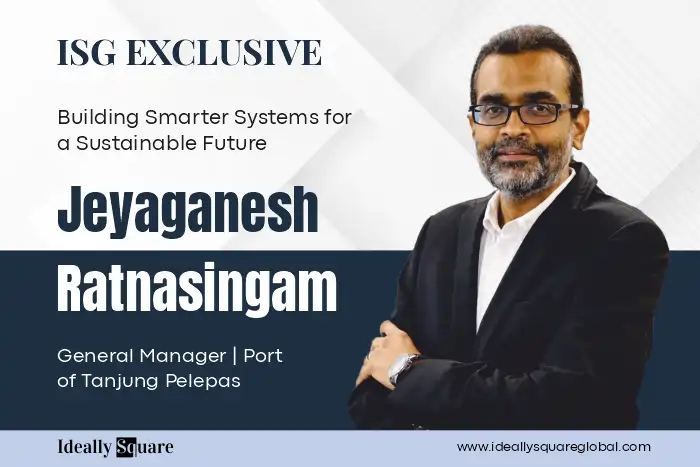
Jeyaganesh Ratnasingam: Building Smarter Systems for a Sustainable Future
A port is built around arrivals and departures, but its greatest challenge lies in everything that must happen between them. While ships cross oceans and cargo moves towards its next destination, thousands of decisions unfold behind the scenes, some immediate, others designed for a future still taking shape. The machinery must keep moving even as better systems are introduced. Infrastructure must grow without disrupting the operations it supports. And every improvement, whether powered by engineering, data, or cleaner energy, must prove that it belongs there.
Jeyaganesh Ratnasingam has spent more than two decades developing that understanding across semiconductors, data storage, advanced manufacturing, rubber and polymer, and maritime operations. Today, as General Manager at Port of Tanjung Pelepas, he leads major engineering and infrastructure projects while advancing operational efficiency, artificial intelligence, sustainability, and decarbonisation.
Beyond the Blueprint of an Engineer
Jeyaganesh’s professional journey spans more than two decades across the semiconductor, data storage, advanced manufacturing, rubber and polymer, and maritime industries. He began his career as an equipment technician and progressively advanced through engineering, operations, project management, and executive leadership roles. Each stage strengthened his belief that sustainable business success comes from integrating technical excellence with strategic thinking and strong leadership.
His interest in engineering was partly inspired by watching a senior family member wearing a hard hat and carrying rolls of drawings. Beyond that early influence, a genuine passion for solving complex problems and creating lasting value continued to guide his journey.
Initially, this involved improving manufacturing processes and delivering successful product transfers. Over time, his focus expanded to supporting key business units across multinational organisations in capability and capacity assessment, investment planning, sustainability, and digital innovation.
Today, as General Manager at Port of Tanjung Pelepas, Jeyaganesh combines engineering, strategic operations, artificial intelligence, and environmental sustainability to help shape the future of one of the region’s leading ports.
For Jeyaganesh, engineering has always been about improving lives, businesses, and society through innovation. That philosophy continues to guide every decision he makes.
The Milestones That Became a Mindset
Several milestones have significantly influenced Jeyaganesh’s approach to leadership.
One was leading complex product transfers and multimillion-dollar capital investment projects across global manufacturing operations. These projects required balancing technical requirements, commercial objectives, stakeholder expectations, and execution risks while maintaining operational continuity.
Another defining experience was establishing Project Management Office governance and standardised project methodologies across organisations. Through this work, Jeyaganesh learned that successful transformation depends not only on technical expertise but also on disciplined governance, transparent communication, and stakeholder alignment.
More recently, leading decarbonisation initiatives and artificial intelligence proof-of-concept projects at Port of Tanjung Pelepas reinforced the importance of creating measurable business and environmental outcomes through innovation. Achieving significant reductions in carbon emissions and operating costs demonstrated that sustainability and profitability can complement rather than compete with each other.
These experiences shaped his leadership philosophy around three principles: leading with integrity, empowering people to make informed decisions, and continually challenging existing ways of working.
Building the Port of Tomorrow
At Port of Tanjung Pelepas, Jeyaganesh’s priorities begin with developing infrastructure and equipment capable of supporting increasing container throughput while maintaining high standards of safety, quality, and operational reliability.
He also focuses on strengthening project governance through structured Project Management Office methodologies, tailored contract management, effective risk management, and disciplined execution.
Innovation represents another strategic priority. Jeyaganesh and his team are actively evaluating artificial intelligence applications that can enhance operational decision-making, improve safety performance, and increase equipment reliability. At the same time, sustainability remains embedded within the port’s investment strategy through initiatives focused on green energy adoption, decarbonisation, and improved energy efficiency.
For Jeyaganesh, innovation should never exist simply for its own sake. Every initiative must create measurable value for customers, employees, shareholders, and the environment.
Making Sustainability Part of the Strategy
Jeyaganesh believes sustainability creates its greatest value when it becomes an integral part of business strategy rather than remaining a compliance exercise.
At Port of Tanjung Pelepas, he has led pilot projects evaluating alternative green energy solutions for terminal equipment as part of the organisation’s broader decarbonisation roadmap. These initiatives have demonstrated encouraging results.
In parallel, the port is exploring artificial intelligence applications to improve operational planning, predictive decision-making, equipment performance, and workplace safety. Rather than replacing people, Jeyaganesh believes AI enables teams to make faster and more informed decisions using real-time operational data.
The combination of sustainability and digital innovation creates a powerful opportunity for organisations to reduce their environmental impact, strengthen operational resilience, optimise costs, and enhance long-term competitiveness.
Intelligence at the Centre of Industrial Transformation
Jeyaganesh believes artificial intelligence will fundamentally change how organisations plan, execute, and optimise projects over the next decade.
In project management, AI will improve forecasting accuracy, automate progress monitoring, identify emerging risks, and support more effective resource allocation. As a result, project managers will increasingly be able to focus on strategic decision-making rather than routine administrative responsibilities.
Within infrastructure development, the combination of AI, digital twins, and predictive analytics will allow organisations to simulate investment scenarios before construction begins, reducing uncertainty and supporting better investment decisions.
Operationally, AI will enable predictive maintenance, optimise asset utilisation, improve scheduling, and strengthen safety through real-time monitoring and intelligent recommendations. These capabilities are particularly valuable in asset-intensive industries such as ports and manufacturing.
However, Jeyaganesh believes technology alone is not sufficient. Successful AI adoption depends on strong governance, quality data, ethical implementation, and developing people with the skills required to work effectively alongside intelligent systems. The organisations that invest equally in technology and talent will be best positioned to lead the next industrial transformation.
Leadership Beyond Technical Expertise
Having managed multimillion-dollar greenfield and brownfield investments while aligning with executive leadership and Boards of Directors, Jeyaganesh believes large-scale strategic projects require much more than technical expertise.
Strategic thinking is essential. Leaders must understand how every investment contributes to long-term business objectives rather than focusing solely on project delivery. Governance is equally important, as clear decision-making frameworks, effective risk management, and transparent reporting build confidence among executive leaders and board members.
Communication also plays a critical role. Large projects involve engineers, operations teams, contractors, regulators, and investors. The ability to communicate clearly and establish trust across these groups often determines project success.
Finally, resilience and adaptability are essential because every major project encounters unforeseen challenges. Throughout his career, these principles have enabled Jeyaganesh to successfully deliver investments exceeding RM100 million while maintaining strong governance, operational continuity, and stakeholder confidence.
Removing Silos to Create Lasting Change
Although semiconductor manufacturing, advanced engineering, and maritime operations differ significantly, Jeyaganesh has found that the principles behind successful transformation remain remarkably similar.
One of his most important lessons is that technology alone never delivers transformation; people do. Organisations often invest heavily in equipment and systems while underestimating the importance of change management, communication, and capability development.
He has also learned that innovation flourishes when organisational silos are removed. Some of the most successful projects he has led brought engineering, operations, finance, procurement, sustainability, and commercial teams together from the earliest planning stages. This cross-functional collaboration improves decision-making, reduces implementation risks, and accelerates value creation.
Jeyaganesh also believes continuous improvement should become part of an organisation’s culture rather than being treated as a series of individual projects. Whether implementing LEAN methodologies, PMO governance, AI solutions, or sustainability initiatives, lasting success depends on creating an environment where improvement becomes everyone’s responsibility.
Connecting Industry Knowledge with the Classroom
As an Adjunct Professor, Jeyaganesh believes industry and academia possess unique strengths and create the greatest value when they collaborate closely.
Universities provide students with strong theoretical foundations, analytical thinking, and research capabilities. Industry complements this knowledge by exposing students to practical challenges, commercial realities, emerging technologies, and leadership responsibilities.
In the classroom, Jeyaganesh draws upon real industrial experiences involving project governance, sustainability strategies, AI implementation, and organisational transformation. These practical insights help students understand how engineering principles are applied within complex business environments.
He also believes collaboration should extend beyond guest lectures. Joint research, industrial placements, innovation partnerships, and experiential learning will become increasingly important in preparing graduates for rapidly evolving industries.
Ultimately, future engineers must be technically competent, commercially aware, digitally capable, and socially responsible.
Where Trust Becomes the Foundation for Growth
Developing people has always been one of the most rewarding aspects of leadership for Jeyaganesh.
He believes effective mentoring begins with trust. People perform at their best when they feel empowered to contribute ideas, challenge existing practices, and learn from both achievements and setbacks while recognising that they are part of something larger.
Jeyaganesh encourages continuous learning by exposing team members to cross-functional projects, structured training, professional certifications, and opportunities that extend their capabilities beyond their comfort zones.
He also prioritises coaching rather than directing. His role is to create an environment where individuals develop confidence in solving problems independently while knowing they have leadership support.
Innovation also requires psychological safety. Teams must feel comfortable experimenting with new ideas without fearing failure. When calculated risks are encouraged and lessons are valued, innovation naturally becomes part of organisational culture.
Jeyaganesh’s ultimate goal is not simply to build high-performing teams but to develop future leaders capable of inspiring others and sustaining organisational success.
Leadership Tested by Complexity
One of the most challenging experiences in Jeyaganesh’s career involved leading large-scale transformation initiatives with significant regulatory involvement and capital investment while balancing operational continuity, stakeholder expectations, and evolving business priorities.
At Ansell, delivering strategic projects required coordinating multiple departments, corporate business units, regulatory authorities, and executive stakeholders without disrupting daily operations. Every decision carried operational, financial, and reputational implications.
The experience reinforced several important leadership lessons. Thorough planning can significantly reduce uncertainty, but leaders must remain flexible because circumstances inevitably change. Transparent communication is equally important in building trust, particularly during periods of uncertainty.
Above all, Jeyaganesh learned that leadership is ultimately about enabling others to succeed. Projects achieve their objectives through collective commitment rather than individual effort.
The experience strengthened his belief that resilience, collaboration, and disciplined execution are the foundations of successful leadership.
The Forces Defining the Next Decade
Jeyaganesh believes several interconnected trends will shape the future of engineering, industrial innovation, and business over the coming decade.
Artificial intelligence will become deeply integrated into engineering, operations, and strategic decision-making. Predictive analytics, autonomous systems, and intelligent automation will significantly improve productivity, workplace safety, and operational resilience.
The energy transition will also continue to accelerate as organisations invest in renewable energy, electrification, hydrogen technologies, and low-carbon infrastructure to meet regulatory expectations and achieve long-term business objectives.
At the same time, sustainability will evolve beyond environmental compliance to become a core business strategy adopted in alignment with international reporting standards. Investors, customers, and regulators increasingly expect organisations to demonstrate measurable environmental, social, and governance performance alongside financial success.
Workforce transformation will become equally important. Jeyaganesh believes future leaders must combine engineering expertise with digital literacy, sustainability knowledge, commercial understanding, and strong leadership capabilities. Organisations that successfully integrate technological advancement with human talent will be best positioned to achieve long-term success.
The Calculated Path to Innovation
For Jeyaganesh, innovation should never compromise operational excellence; instead, it should strengthen it.
He encourages experimentation by ensuring that new ideas are evaluated through structured pilot projects or proof-of-concept initiatives before wider implementation. This approach enables teams to explore new possibilities while effectively managing operational and financial risks.
Data-driven evaluation remains central to informed decision-making. Rather than relying on assumptions, ideas should be tested against measurable outcomes to determine their value and potential for broader implementation.
Jeyaganesh also believes recognising and celebrating learning is essential. Not every experiment will deliver the expected outcome, but every initiative can generate valuable insights that contribute to better decisions in the future.
When leaders demonstrate openness to new ideas while maintaining accountability and strong governance, organisations naturally develop an environment where innovation and operational discipline reinforce one another.
A Legacy Measured Through People
While Jeyaganesh takes pride in managing large investments, engineering excellence, and sustainability efforts, he sees developing people as his most notable accomplishment.
Jeyaganesh has had the honour of coaching engineers, project managers, and leaders throughout his career, watching as they have climbed the ladder of success. To watch others succeed as a result of opportunity, mentorship, and trust has continued to give him great satisfaction.
On a professional level, Jeyaganesh is also proud of his ability to add value in organisations undergoing transformation. Some of Jeyaganesh’s accomplishments include implementing technology solutions, improving project management systems, initiating decarbonization efforts, and promoting artificial intelligence.
What Jeyaganesh hopes to leave behind is a legacy of responsible leadership, knowing that he has done something worthwhile while nurturing people who keep making a difference even after the leader moves on.
Unlearning to Relearn
Jeyaganesh’s advice to young engineers, project managers, and emerging leaders begins with a simple principle: never stop learning or, as he expresses it, “Unlearn to Relearn.”
Technical knowledge is vital for a flourishing career, yet success in the long term requires equal amounts of communication, leadership, strategy, managing stakeholders and adaptability.
As far as he recommends young professionals to seek chances that will challenge them instead of sticking to their comfort zones, some of the most beneficial experiences in his career life were gained by taking up roles which were outside of his comfort zone in other industries and disciplines.
Another important point Jeyaganesh makes is about the importance of credibility earned through integrity, consistency, and commitment to fulfilment. Leaders who are reliable, cooperative and supportive are remembered by people.
Lastly, Jeyaganesh advises aspiring leaders to make use of technology and not forget about people as well. While artificial intelligence, automation and digital transformation will keep changing industries, leadership will be all about motivating people and decision-making that brings value to society.
Building Progress That Outlives Leadership
According to Jeyaganesh, this is the era of transformation due to technological innovations, sustainability issues, and changes in the global economy.
Leaders have to rise above and beyond the level of delivering mere financial performance. Leaders need to create organisations that are innovative, resilient, eco-friendly, and committed to building people.
The act of innovation must always be towards achieving something worthwhile. Either for enhancing the lives of people, strengthening the community, safeguarding the environment or even creating economic value, the progress has to go beyond the organisation for it to make a real difference.
Jeyaganesh is still optimistic about the future as he has seen the kind of difference that can be made by a team brought together by a common vision. Through engineering excellence, responsible leadership, innovation in the digital world, and sustainability, organisations can achieve commercial success and make an impact on society at the same time.
Jeyaganesh Ratnasingam - “Building Smarter Systems for a Sustainable Future”
“For me, engineering has always been about improving lives, strengthening businesses, and creating meaningful value for society through innovation.”
“Innovation should never exist for its own sake. Every initiative must create measurable value for people, businesses, and the environment.”
“I believe sustainability creates its greatest value when it becomes part of business strategy rather than remaining a compliance exercise.”
Read the full issue
Open Magazine →