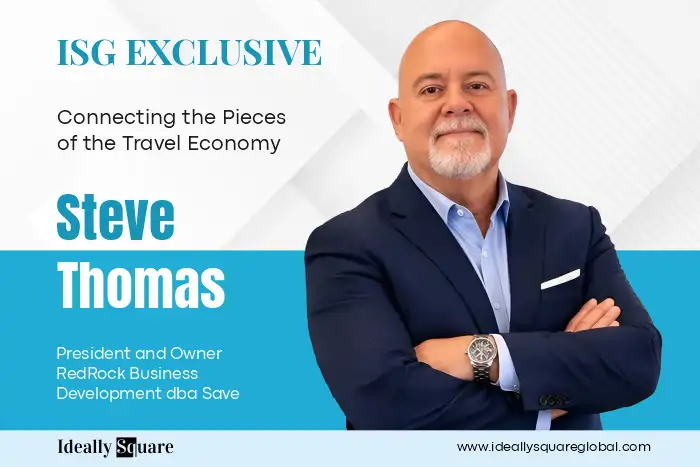
Most Influential Travel & Vacation Business Leaders to Watch in the USA
With nearly three decades of experience across travel and vacation ownership, Steve Thomas has built his career around connecting marketing, sales, fulfillment, technology, partnerships, and customer experience. As President and Owner of RedRock Business Development and Save on Travel 365, he focuses on creating practical, flexible, and sustainable travel programs built on trust, transparency, and long-term value.
Steve Thomas: Connecting the Pieces of the Travel Economy
The travel industry has always been in the business of selling possibility. A brochure once promised a beach. A website now offers thousands of destinations in seconds. Yet the real product has never been a hotel room, a flight, or a resort stay. It is the feeling that comes before the journey begins. The excitement of planning an escape. The confidence that everything will work as promised. The belief that time away will be worth the investment. Creating that feeling requires far more than marketing. It demands an understanding of people, trust, timing, partnerships, and the countless decisions that shape a travel experience long before a suitcase is packed.
Steve Thomas has spent nearly three decades learning exactly how that machinery works. His career has taken him through virtually every corner of the vacation ownership and travel business, from sales floors and call centers to marketing programs, resort partnerships, business development initiatives, and customer engagement strategies. Today, as President and Owner of RedRock Business Development and Save on Travel 365, he brings together years of hands-on experience to create travel programs that balance innovation with practicality.
Learning the Business of Vacation Experiences
Steve's journey in the travel and vacation ownership industry began in 1996 with Fairfield, which later became part of Wyndham. What initially attracted him to the sector was its dynamic combination of travel, sales, marketing, customer engagement, and opportunity. Over the years, he gained experience with some of the industry's most recognized brands, including Marriott, Diamond Resorts, Welk Resorts, and Bluegreen.
Over time, Steve’s career progressed beyond sales and marketing into leadership, call-center management, program development, and business development. Managing operations involving approximately 100 agents and developing new marketing and customer-acquisition programs gave him experience not only in generating business, but in understanding how sales, operations, fulfillment, and customer experience must work together. Those experiences ultimately provided the foundation for him to build and operate his own business.
Throughout his career, Steve worked across a broad range of functions, including owner and non-owner referrals, marketing programs, tour generation, and large-scale call-center operations. Managing teams of approximately one hundred agents and developing innovative initiatives such as experiential "party weekends" taught him an important lesson early on: people respond far more positively to memorable experiences than to traditional sales tactics.
Reflecting on nearly three decades in the industry, Steve believes adaptability has been the defining factor behind long-term success. Consumer expectations evolve, technology advances, and marketing methods shift. For him, sustained growth comes from embracing change rather than relying on yesterday's formulas.
Seeing the Customer Journey as a Complete System
Having worked across marketing, sales, business development, call-center management, vacation ownership, travel clubs, and resort operations, Steve developed a holistic understanding of the customer experience.
His career has allowed him to view the industry from virtually every angle. He has generated leads, managed call centers, worked closely with sales teams, collaborated with resorts and fulfillment providers, and eventually analyzed the financial mechanics behind entire programs as a business owner.
This experience reinforced his belief that no single department operates independently. Marketing success depends on qualified leads. Sales performance relies on accurate expectations. Customer satisfaction requires fulfillment teams that can consistently deliver on promises. Sustainable profitability emerges only when every component works in harmony.
As a result, Steve approaches business strategy by evaluating the entire customer lifecycle, from initial contact and qualification to fulfillment and long-term engagement.
Building RedRock Through Industry Experience
RedRock Business Development emerged from Steve's desire to bring together the many moving parts of the vacation ownership and travel marketing ecosystem.
He recognized that resorts need qualified customers, marketing organizations need reliable fulfillment solutions, and travel programs can create compelling incentives. The challenge lies in aligning these components into programs that make operational and financial sense for everyone involved.
Through RedRock, Steve has developed and managed initiatives ranging from Day Drives and Road Shows to Mini Vacations and more recently Webinar and Zoom-based appointment programs.
Rather than focusing solely on volume, he prioritizes sustainability. He believes successful programs must be practical, measurable, and adaptable. When performance data reveals opportunities for improvement, he is quick to refine strategies rather than maintain ineffective approaches simply because they have been used historically.
Partnerships Built on Trust and Transparency
For Steve, successful partnerships begin with understanding the objectives and economics of every stakeholder involved.
He recognizes that resort developers, call centers, marketing firms, and fulfillment providers each operate with different priorities and performance metrics. Programs become most effective when those interests are aligned rather than competing against one another.
Throughout his career, Steve has placed significant value on communication, transparency, and long-term relationships. He believes that strong partnerships are not defined by the absence of challenges but by the willingness of partners to openly discuss issues, make adjustments, and work collaboratively toward solutions.
Reputation also plays a critical role. Having worked alongside many industry professionals for years, he understands that trust and reliability remain among the most valuable assets in any business relationship.
Adapting to a New Generation of Travelers
The evolution of consumer behavior has dramatically transformed how travel programs are designed and delivered.
Earlier in his career, traditional channels such as direct mail, radio advertising, and outbound calling dominated customer acquisition strategies. While those methods still have relevance, modern consumers expect convenience, speed, and digital accessibility.
Steve has embraced these changes by integrating technologies such as webinars, Zoom presentations, email communications, and digital scheduling tools. He recognizes that today's travelers value flexibility and prefer to engage with products and services on their own terms.
The growing adoption of virtual presentations has created new opportunities, allowing consumers to learn about travel products without sacrificing valuable vacation time.
Flexibility as the New Standard
According to Steve, flexibility has become one of the most important expectations among today's travelers.
Modern consumers increasingly seek freedom in how they use travel products and vacation benefits. They want options rather than restrictions and appreciate programs that allow them to choose destinations and experiences that fit their preferences.
Transparency has become equally important. Steve believes businesses should clearly communicate fees, qualification requirements, and participation expectations from the beginning. While greater transparency may occasionally reduce short-term conversions, it significantly improves customer satisfaction and trust over the long term.
For him, informed customers are more likely to become satisfied customers.
Creating Vacation Products That Deliver
Steve understands the challenges call centers face because he has managed them himself.
In his view, successful vacation programs require more than attractive offers. Agents need products they can confidently explain, while customers need experiences that can be reliably delivered.
Destination variety remains an important factor because consumer preferences continue to diversify. Equally important is having fulfillment partners capable of supporting customers when questions or issues arise.
Rather than focusing on promotional headlines, Steve believes the strongest travel products are those supported by dependable operations and consistent execution.
Balancing Sales Performance with Customer Satisfaction
Steve rejects the notion that sales goals and customer satisfaction are opposing forces. In his experience, the most successful sales outcomes occur when customers have positive experiences.
Setting clear expectations remains the foundation of this philosophy. Customers should fully understand what they are purchasing, what responsibilities they have, and what benefits they can expect.
He emphasizes the importance of proactive communication through confirmations, reminders, reservation assistance, and accessible customer support. Direct customer interactions have provided him with valuable insights into areas where businesses can improve processes and enhance experiences.
For Steve, customer service should function as a source of continuous business intelligence rather than merely a department that handles complaints.
Choosing Channels Based on Results, Not Trends
Having worked with channels ranging from direct mail and radio to Google, Facebook, Instagram, Messenger, email marketing, webinars, and Zoom, Steve takes a data-driven approach to marketing decisions.
Rather than becoming attached to specific platforms, he focuses on identifying which channels produce qualified customers at sustainable acquisition costs.
His evaluation process includes analyzing response rates, qualification rates, appointment conversions, show rates, sales performance, and customer acquisition costs.
While technology has made more information available than ever before, Steve believes the real advantage comes from using that information intelligently to guide strategic decisions.
Compliance as a Competitive Advantage
Steve considers compliance, data protection, and responsible lead generation essential components of modern travel marketing.
As regulations continue to evolve, businesses must understand how leads are generated, how consent is obtained, and whether proper disclosures have been provided throughout the marketing process.
He advises organizations to carefully vet marketing partners, document consent procedures, maintain transparent terms and conditions, and ensure teams understand regulatory requirements.
For Steve, compliance extends beyond legal protection. It helps establish trust from the very first interaction. When customers clearly understand why they are being contacted and what is being offered, the foundation for a stronger and more sustainable relationship is already in place.
Leading People, Not Just Performance
Throughout his career, Steve has led teams ranging from small groups to operations involving more than one hundred agents. This experience taught him that effective leadership is not about applying a single management style to everyone. Different individuals are motivated by different factors. Some thrive on competition, others value recognition, while many benefit from coaching and ongoing development.
Steve believes successful leaders take the time to understand what motivates each team member while maintaining clear and consistent expectations. Training also plays a critical role in long-term success. In his view, effective training goes beyond scripts and procedures. Employees need to understand the purpose behind their actions, how to address customer concerns, and how their work contributes to the broader organization.
Accessibility remains another important leadership principle for him. Regardless of position or title, Steve has always valued staying connected to frontline operations, believing that some of the most valuable business insights come directly from employees interacting with customers every day.
The Power of Momentum
One leadership principle that has significantly influenced Steve's approach to business is what he describes as the "Law of Momentum."
Over the years, he has come to appreciate the importance of nurturing what is already working rather than focusing exclusively on the next opportunity. Whether it involves customer relationships, employee development, marketing initiatives, or strategic partnerships, Steve believes sustained success often comes from investing in proven strengths.
At the same time, he emphasizes that momentum should not be confused with complacency. Businesses must continually measure performance, evaluate outcomes, and make adjustments when necessary. For Steve, momentum means identifying positive progress, supporting it, protecting it, and allowing it to grow over time through consistent effort and attention.
A New Era of Travel Opportunities
Looking toward the future, Steve sees significant opportunities emerging between traditional vacation ownership models and conventional travel booking platforms.
He believes many consumers still have a strong desire to travel but increasingly seek flexibility rather than long-term commitments tied to specific destinations or vacation formats. This shift has created growing demand for travel memberships, lifestyle benefits, discounted accommodations, and flexible vacation programs that offer greater freedom and personalization.
Technology has also expanded opportunities for customer engagement. Virtual presentations, online consultations, and digital membership platforms allow businesses to connect with consumers regardless of geographic location. Companies can now reach customers nationwide without requiring them to visit physical sales centers.
Despite these technological advances, Steve remains convinced that human interaction will continue to play an essential role. In his view, the greatest opportunities will come from combining digital convenience with responsive, personalized customer service.
Building Sustainable Growth for the Future
As President and Owner of RedRock Business Development and Save on Travel 365, Steve's priorities remain firmly focused on sustainable growth.
Through RedRock, he continues to collaborate with resort developers, travel organizations, marketing companies, and call centers where his industry expertise and long-standing relationships can create measurable value. At the same time, he is actively focused on expanding Save on Travel 365 through vacation offerings that provide consumers with greater flexibility while giving marketing partners products they can confidently promote.
Rather than pursuing growth solely for the sake of size, Steve prioritizes profitability, operational discipline, strong partnerships, and customer satisfaction. He believes that a well-managed organization with sustainable economics ultimately creates more long-term value than a business focused exclusively on volume.
He is also particularly interested in expanding virtual marketing and presentation models, recognizing that convenience will continue to influence how consumers evaluate travel and vacation-related products in the years ahead.
Save on Travel 365 is designed to provide flexible vacation products and fulfillment solutions that give consumers broader destination choices while providing call centers and marketing partners with a reliable travel product they can confidently promote and support.
Lessons From Nearly Three Decades in Business
Drawing on almost thirty years of experience, Steve offers several principles for entrepreneurs, marketers, sales professionals, and business owners entering the travel, hospitality, vacation ownership, and travel-club sectors.
First, he encourages professionals to understand every aspect of their business rather than focusing solely on revenue generation. Marketing costs, fulfillment expenses, customer experience, partnerships, compliance requirements, and operational efficiency all contribute to long-term success.
Second, he emphasizes the importance of protecting relationships. Having spent nearly three decades in the industry, Steve understands how interconnected professional networks become over time. Today's colleague, partner, or client may become tomorrow's most valuable business opportunity.
Adaptability is another recurring theme in his philosophy. Experience, he believes, is not about always being correct. It is about recognizing when assumptions no longer align with reality and being willing to make necessary changes.
He also stresses the distinction between revenue and profitability. Impressive sales figures may attract attention, but sustainable businesses are built on sound economics and disciplined financial management.
Ultimately, Steve believes that relationships open doors, but performance, integrity, and consistency are what keep those doors open.
The Future Belongs to Experiences
Steve sees an increasing convergence between travel, vacation ownership, membership programs, and technology. From the consumer’s perspective, these categories are becoming less important than the experience itself. Travelers want value, flexibility, convenience, and choices, but they also want confidence that the company behind the experience will be there when assistance is needed.
For businesses, this convergence creates both opportunity and responsibility. Technology allows companies to offer more flexible and accessible travel solutions, but the marketing message, sales process, and actual customer experience must remain aligned.
Despite the tremendous technological advances since Steve entered the industry in 1996, he believes one fundamental principle has remained unchanged: travel is still a relationship business. Whether the relationship is with a customer, resort developer, call-center operator, salesperson, or strategic partner, trust remains essential. Technology will continue to reshape how the industry operates, but Steve believes genuine relationships and personal service will remain irreplaceable.
Steve Thomas
"A marketing campaign can generate tremendous volume, but if the customer experience breaks down, the entire program suffers."
"The goal has never been simply to generate volume. I want to build programs that can be fulfilled, sustained, and improved over time."
"The strongest partnerships are built on communication, transparency, and a willingness to solve problems together."
Read the full issue
Open Magazine →